The following information was compiled to form the basis of a talk I gave to the Science Group of Warrington University of the Third Age (U3A) in April 2026.
I chose to start with the Rocket because it set the benchmark for all future steam locomotives. I ended with The Duke as it was the final design of steam locomotive built by British Railways for main line operation.
Page 2 – Penydarren
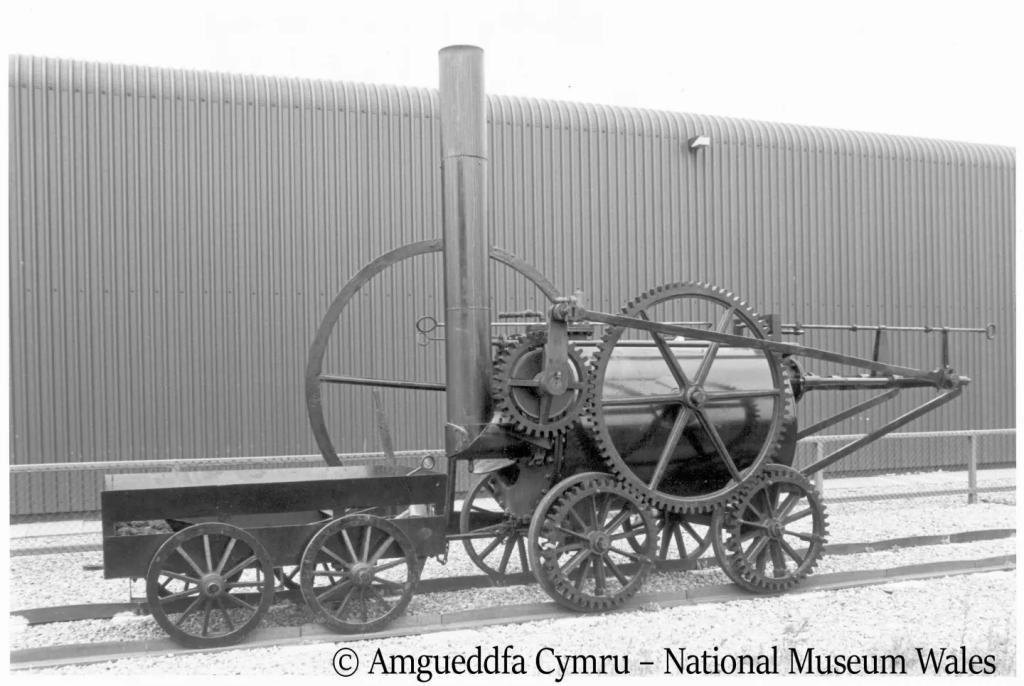
Penydarren was built by Richard Trevithick and made the made the first locomotive hauled railway journey in the world in 1804. It operated on the nine miles of railway between the iron works at Penydarren and the Merthyr-Cardiff Canal, in Merthyr Tydfil in Wales.
On the first run the engine hauled ten tons of iron in five wagons and seventy men riding on them. The engine achieved a speed of nearly 5 mph.
On the return journey a bolt sheared, causing the boiler to leak. The fire then had to be dropped and the engine did not get back to Penydarren until the following day.
The engine was, in fact, too heavy for the rails. Later, it would serve as a stationary engine driving a forge hammer at the Penydarren works.
It was to be several years before steam locomotion became commercially viable and hence the claim that Richard Trevithick and not George Stephenson was the real father of the railways.
Page 3 – Locomotion No1 – Stockton & Darlington Railway
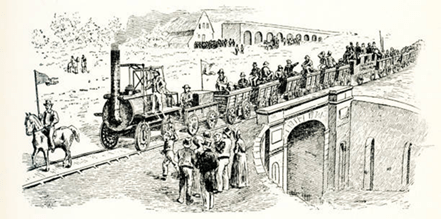
The Stockton & Darlington Railway opened in September 1825. It was the first public railway in the world to convey goods and passengers using steam traction. The first train consisted of six trucks filled with coal, a further six loaded wagons, a passenger coach and twenty-one trucks crowded with people. Stephenson was driving Locomotion and he managed to get the speed up to 8mph.
It was the first locomotive to use coupling rods to link the driving wheels. Earlier engines used a chain or gears.
It used high pressure of 50psi to feed the vertical cylinders.
Locomotion was not George Stephensons first steam locomotive – that was built in 1814. This earlier engine demonstrate that steam locomotives could replace horses. It also demonstrated that metal wheels on metal rails would provide sufficient grip.
Page 4 – Rocket
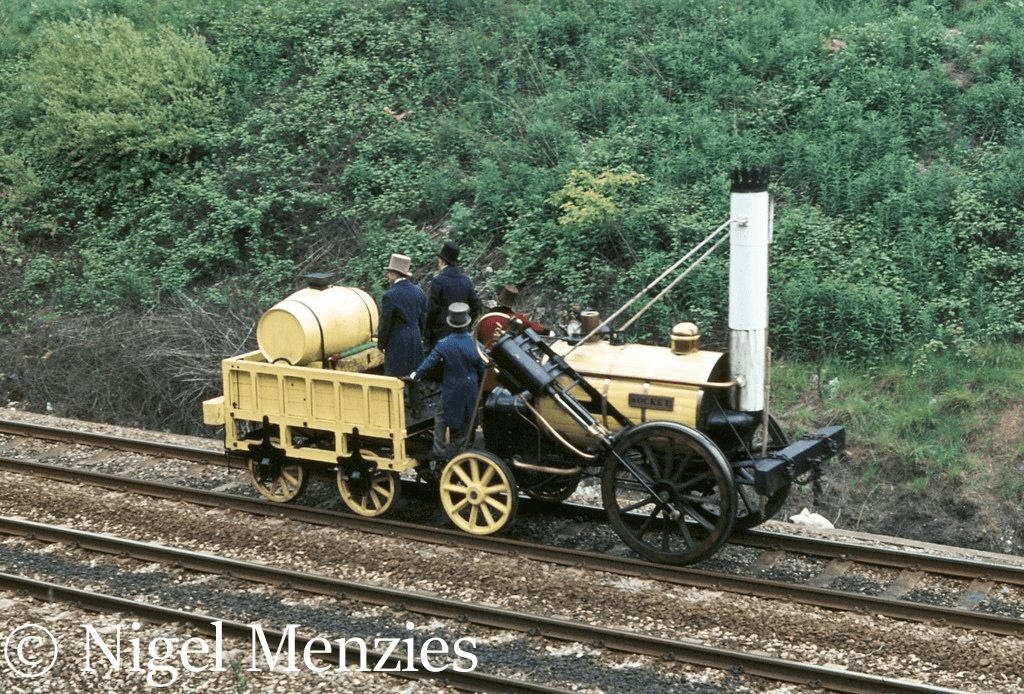
Rocket was built at Newcastle, dismantled and transported to Port Carlisle by cart, then taken to Liverpool by sea before being reassembled
It must be remembered that the Rocket was built to win the competition – Anyone involved in target setting knows the importance of getting them right.
One of the conditions of the trial was that the locomotive had to haul a weight three times greater than its own weight. The locomotive was deliberately built to weigh as little as possible for the trial but this may not have been ideal for working on the railway subsequently. The wheels were made of wood with metal tyres to save weight
Rocket was the only locomotive to complete the trials. It averaged 12 miles per hour (achieving a top speed of 30 miles per hour hauling 13 tons, and was declared the winner of the £500 prize. The Stephensons were accordingly given the contract to produce locomotives for the Liverpool & Manchester Railway.)
the line opened in September 1830.
It was the first railway to have double track for its entire length –
Locomotives of Rocket’s era were fired by coke rather than coal. More on this later.. It was not until 30 years later and the development of the long firebox that locomotives would be able to burn coal effectively.
Within a few years of being built, the Rocket had been much modified. The cylinders were altered to a near-horizontal position, compared to the angled arrangement as new; the firebox capacity was enlarged and the shape simplified; and the locomotive was given a drum smokebox.
It worked on the Liverpool & Manchester Railway until 1836, when it was sold t work at the Naworth collieries at Brampton in Cumberland. This railway was a ten-mile-long track branch railway line on the borders of Cumberland and Northumberland The line connected via spurs to eight collieries.
Rocket was withdrawn around 1840 and it was then stored in a shed until 1851 when it was moved to Stephenson’s works in Newcastle It remained at the works until it became part of the collection at the Patent Museum in 1862.
The Patent Museum subsequently became the Science Museum in London. Its
In September 2019 Rocket was put on public display at the National Railway Museum at York which is now its permanent home. It is interesting to see it next to a replica which shows it as originally built.
Page 5 – Rocket – Diagram
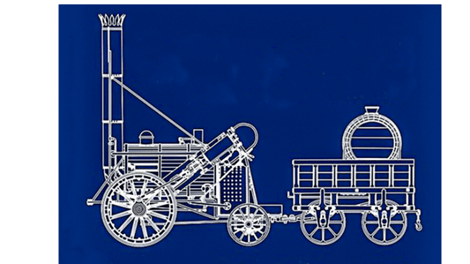
Rocket was the world’s first steam locomotive to combine a multi-tube boiler with draught induced by exhaust steam. This is the principle upon which later steam locomotives operated.
Rocket also used a blastpipe, feeding the exhaust steam from the cylinders into the base of the chimney so as to induce a partial vacuum and pull air through the fire.
Credit for the invention of the blastpipe and the multiple fire-tubes is disputed.
The blastpipe worked well on the multi-tube boiler of Rocket but on earlier designs with a single flue through the boiler it had created so much suction that it tended to rip the top off the fire and throw burning cinders out of the chimney
The steam was directed to the two ends of the cylinders by valves driven by, and linked from, eccentric drivers rotating about the driving axles. The locomotive was reversed by an axial movement of the eccentrics between forward and reverse ‘dogs’ clamped to the axle.
Page 6 – Eat own smoke
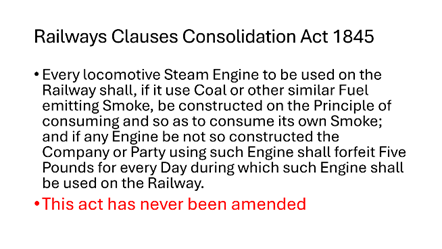
Locomotives of Rocket’s era were fired by coke rather than coal. Local landowners imposed regulations on most new railways that locomotives would ‘consume their own smoke
Page 7 – Planet
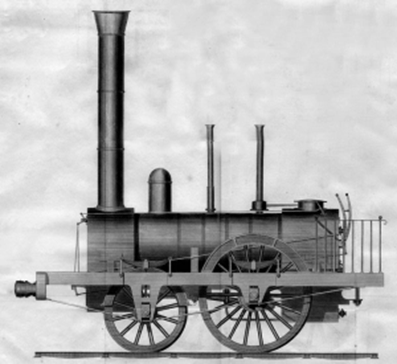
When the original Planet was built in 1830 it was the ninth locomotive to be built for the Liverpool & Manchester Railway. It was built by Robert Stephenson and was a major advance on Rocket.
It had inside cylinders and a steam dome to prevent water from entering the locomotive’s cylinders,
It was the first locomotive in Britain to have buffers and coupling mechanism.
In November 1830 the locomotive covered the 30 miles between Liverpool and Manchester in one hour.
Original had boiler pressure of 50psi but the replica built in 1992 had a boiler pressure of 100psi due to use of more modern materials.
As the locomotive works of Robert Stephenson were at Newcastle it was considered preferable to build and maintain the locomotives for the line closer. In 1832 Robert Stephenson became a partner in the Vulcan Foundry at Newton le Willows and remained so for a few years.
The earliest authenticated locomotives to be built at Vulcan Foundry were delivered to the Liverpool & Manchester Railway in 1834. Later built locomotives for abroad including Japan and China.
Page 8 -Domed Boiler
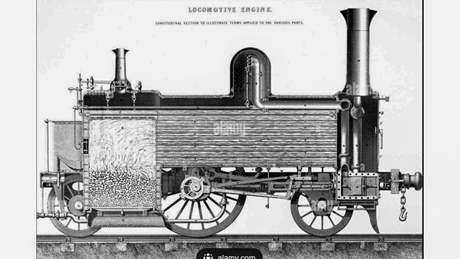
The steam dome is a vessel fitted to the top of the boiler of a steam engine. It contains the opening to the main steam pipe and its purpose is to allow this opening to be kept well above the water level in the boiler. This arrangement acts as a simple steam separator and minimises the risk that water will be carried over to the cylinders. where it might cause a hydraulic lock.
Page 9 – Safety Valve
On the Stockton and Darlington Railway, the safety valve tended to go off when the engine hit a bump in the track. A valve less sensitive to sudden accelerations used a spring to contain the steam pressure, but these (based on a Salter spring balance) could still be screwed down to increase the pressure beyond design limits. This dangerous practice was sometimes used to marginally increase the performance of a steam
engine.
In 1828, Locomotion was heavily damaged when its boiler exploded killing its driver, The explosion was due to the driver having tied down the safety valve which caused the boiler pressure to rise. This was the third serious accident involving early locomotives in a seven month period.
In 1856, John Ramsbottom invented a tamper-proof spring safety valve that became universal on railways. The Ramsbottom valve consisted of two plug-type valves connected to each other by a spring-laden pivoting arm, with one valve element on either side of the pivot. Any adjustment made to one of valves in an attempt to increase its operating pressure would cause the other valve to be lifted off its seat, regardless of how the adjustment was attempted. The pivot point on the arm was not symmetrically
located between the valves, so any tightening of the spring would cause one of the valves to lift.
The Ramsbottom safety valve became a standard component on many British railways, contributing significantly to the safety and reliability of steam locomotives.
Page 10– Valve Gear & Cylinders
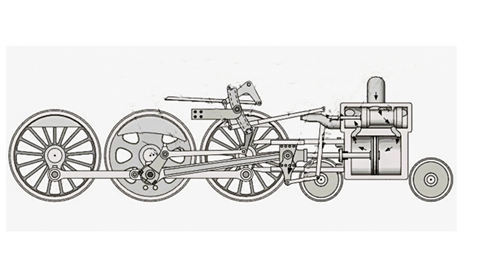
Valve gear performed three major functions
• The direction the locomotive moved in
• The timing of the steam entering the cylinder to move the piston forcing the driving wheels to turn •
• The timing of the exhaust of steam to the blast pipe and chimney
The valve gear also enable the driver to adjust the point at which the steam is admitted to the cylinder. The greatest power is achieved by keeping the inlet valve open throughout the power stroke. This results in having th e full boiler pressure against the piston throughout the stroke. This is used when starting a train from standing or when working very hard. Peak efficiency is achieved by only having the inlet valve open for a short time and then letting the steam expand in the cylinder which may be possible when the locomotive is running at speed.
The point at which steam stops being admitted to the cylinder is known as the cutoff, and the optimal position for this varies depending on the work being done and the trade off desired between power and efficiency.
Page 11 – Water Troughs
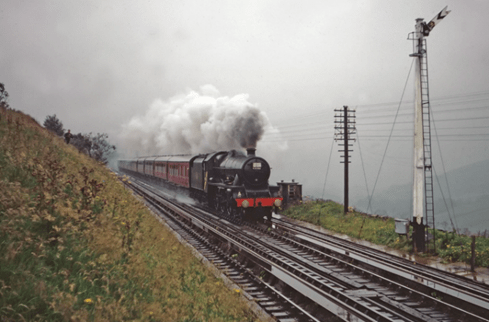
 Preserved British Steam Locomotives