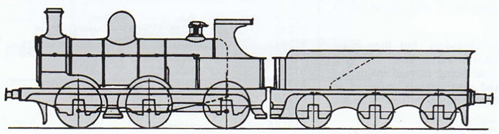
| Power Classification | 2F |
| Introduced | 1876 – 1887 (all survivors built in 1887) |
| Designer | Barton Wright |
| Company | L&YR |
| Weight – Loco | 39t 1cwt |
| Driving Wheels | 4ft 6ins |
| Boiler Pressure | 140psi |
| Cylinders | Inside – 17½in x 26in |
| Tractive Effort | 17,545lbf |
| Valve Gear | Stephenson (slide valves) |
Barton Wright introduced his standard 0-6-0 in 1876 and a total of 280 were built up to 1887. When Aspinall built his 0-6-0s in 1889 (class 27 engines), many of these engines became surplus to requirements and all except the last fifty were rebuilt as saddle tanks becoming the 51307 or 23 class.
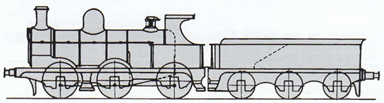 |
As originally built as a class 25 engine. |
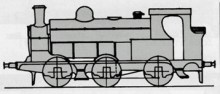 |
As rebuilt as a saddle tank by Aspinall to become class 23 engines |
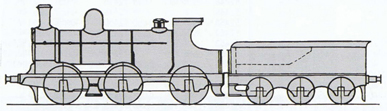 |
Class 27 introduced by Aspinall in 1889 |
At the time the locomotives were converted to saddle tanks the L&YR had an acute shortage of shunting engines. 230 were rebuilt between 1891 and 1900. 96 of these engines came into BR stocks numbered in the range 51307-51530 plus service engines numbered in the range 11304-11394.
The engines were withdrawn from 1930 onwards and twenty-five of the un-rebuilt fifty survived to become BR locomotives in 1948. Of these twenty-five which were all built in 1887, ten had been built by Vulcan Foundry Ltd and fifteen by Beyer Peacock & Co Ltd. The original 230 had been built by a wide range of manufacturers as L&YR did not have Horwich to build locomotives until 1889.
As at 1st January 1948 they were allocated as follows.
| Goole |
5 |
| Patricroft |
6 |
| Preston |
3 |
| Wakefield |
2 |
| Wigan Springs Branch |
9 |
|
25 |
Only one remained in service beyond 1955 and it (52044) was withdrawn in June 1959 whilst based at Wakefield.
Preservation
Back to LMS
Back to Locomotives
 Preserved British Steam Locomotives