
| Power Classification | 4MT reclassified 3MT in 1953 |
| Introduced | 1906 – 1915, 1924 – 1927 |
| Designer | Churchward |
| Company | GWR |
| Weight | 57t 0cwt |
| Driving Wheels | 4ft 7.5ins |
| Boiler Pressure | 200psi superheated |
| Cylinders | Outside – 17in x 24in |
| Tractive Effort | 21,250lbf |
| Valve Gear | Stephenson (piston valve) |
As an extension to the large Prairie tanks first produced in 1903, a prototype number 115, with smaller dimensions was built in 1904 to work the hilly branch lines of the West Country and Wales. Equipped with driving wheels of four feet one and a half inches, a smaller boiler than the larger prairie and cylinders of seventeen inches by twenty-four inch stroke, it was an immediate success and less than a year after its introduction, a further ten locomotives were ordered to be built at Wolverhampton. The class became numbers 3101-3110 for a short time until renumbered 4401-4410 with the prototype renumbered 4400.
When additional locomotives were required, it was felt that the driving wheel diameter was rather small for any fast running and so limiting their use.
The 4500 class was developed directly from the 4400 class, but they were fitted with larger wheels and higher pressure boilers.
 |
4400 class |
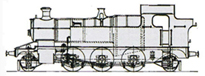 |
4500 class |
The original for this series of locomotives was built in 1904 at Swindon as number 115 which was a small version of the 3100 class (later 5100 class). It was designed for light branch work and proved to be an immediate success over the hilly branch lines in the West Country. 115 was renumbered 4400 and ten more were built at Wolverhampton in 1905-6.
4500-4519 were built at the Stratford Works at Wolverhampton in 1906-1908 – the last locomotives to be built there. Of this batch 2168 (as 4507) was the last Wolverhampton-built locomotive to remain in service with BR, not being withdrawn until 1963. The earlier locomotives were built without superheaters, but were subsequently superheated. A total of 75 were built which included a final batch of 20 during Collett’s tenure at Swindon.
They were a popular class and were very effective and efficient on branch line work. The first fifty originally were fitted with inside steam pipes but many later received outside steam pipes. There was some variation in the size and shape of the bunkers.
Later engines had larger side tanks to increase the water capacity and had sloping tops to the tanks. These were known as the 4575 class.
 |
4500 class |
 |
4575 class |
4500 class locomotives in service.
|
Date |
Numbers | Quantity | Withdrawals |
No. in Service |
| 1906 | 4500-2 | 3 | 3 | |
| 1907 | 4503-15 | 13 | 16 | |
| 1908 | 4516-19 | 4 | 20 | |
| 1909 | 4520-24 | 5 | 25 | |
| 1910 | 4525-29 | 5 | 30 | |
| 1913 | 4530-39 | 10 | 40 | |
| 1914 | 4540-47 | 8 | 48 | |
| 1915 | 4548-54 | 7 | 55 | |
| 1924 | 4555-74 | 20 | 75 | |
| 1925-49 | 75 | |||
| 1950 | 4 | 71 | ||
| 1951 | 3 | 68 | ||
| 1952 | 5 | 63 | ||
| 1953 | 11 | 52 | ||
| 1954 | 0 | 52 | ||
| 1955 | 13 | 39 | ||
| 1956 | 0 | 39 | ||
| 1957 | 3 | 36 | ||
| 1958 | 8 | 28 | ||
| 1959 | 6 | 22 | ||
| 1960 | 5 | 17 | ||
| 1961 | 6 | 11 | ||
| 1962 | 5 | 6 | ||
| 1963 | 4 | 2 | ||
| 1964 | 2 | 0 |
- 4503 – 4519 were built at Stafford Road Wolverhampton
- 4520 – 4574 were built at Swindon
The first withdrawal of the 4500 class was number 4531 in 1950 and the last in service 4564 which lasted in service until September1964. Most of the later withdrawals were of those introduced in 1924 (19 of the 22 withdrawn in the years 1960-64). The last earlier locomotive in service was 4507 which was built in 1907 at Stratford Works at Wolverhampton and withdrawn from service at Yeovil Town depot in October 1963. The other three withdrawals in 1963 were from Plymouth Laira and the two in 1964 were from Gloucester (4564 withdrawn September 1964) and Swindon (4569 withdrawn August 1964).
 Preserved British Steam Locomotives