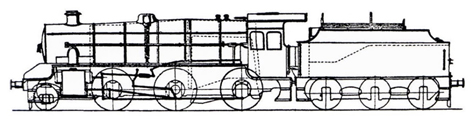
| Power Classification | 5F reclassified 5MT 6P5F in 1948 |
| Introduced | 1933 – 1934 |
| Designer | Stanier |
| Company | LMS |
| Weight – Loco | 69t 2cwt |
| Tender | 42t 4cwt |
| Driving Wheels | 5ft 6ins |
| Boiler Pressure | 225psi superheated |
| Cylinders | Outside – 18in x 28in |
| Tractive Effort | 26,290lbf |
| Valve Gear | Walschaert (piston valves) |
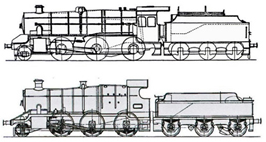
Although all built at Crewe Works, they were designed at Horwich Works and were developed from the Horwich Mogul, the LMS Hughes Crab 2-6-0. They had the addition of several features brought over from the Great Western Railway (GWR) by newly arrived Chief Mechanical Engineer Stanier, most notably the taper boiler. Stanier would have been familiar with the GWR 4300 class which was the first modern 2-6-0 class designed by Churchward and introduced in 1911.
 |
LMS 5MT
|
The Stanier Moguls were arguably the first design of locomotive by the LMS’s new Chief Mechanical Engineer, William Stanier. 13245 appeared on 21st October 1933, some four months after 6200 The Princess Royal, although the latter had been rushed through production as a prestige engine. In an effort to please Stanier, Horwich had designed in a GWR style top-feed cover and locomotive 13245 appeared with the feature fitted. Stanier was not at all pleased, ordering it promptly removed and replaced with the normal LMS cover.
It was found possible to give the engine horizontal cylinders (the only Stanier design to do so) by increasing the boiler pressure, while decreasing the cylinder diameter. This allowed these engines to have approximately the same tractive effort as the Hughes engines.
On the first twenty the boiler cladding sheets followed the contour of the barrel below, so that there was a parallel front section with all the taper concentrated to the rear. The next twenty had a continuous taper from smokebox to firebox, to which profile the others were eventually modified. The first thirty had a Midland-type bell whistle, but a Stanier Caledonian-type hooter was fitted to the final ten.
They were all built before the introduction of Stanier’s curved-topped 4000 gallon tender, so were fitted with the then standard Fowler 3,500 gallon type that was narrower than the locomotive, which they retained throughout their lives. When built the first ten locomotives had no water pick-up gear fitted to their tenders.
The engines originally had small superheaters but were later fitted with 21 element superheaters.
All were built at Crewe, but were allocated to Horwich for repair. This situation was changed from December 1963, when repairs were reallocated to Swindon. They were always painted black, with red lining in LMS days and BR’s mixed traffic LNWR-derived red, cream and grey lining from 1948. Some war-time repaints were into plain black without lining.
They were initially numbered 13245–13284 (following on from the crabs), but as standard locomotives, in the LMS 1933 renumbering scheme they were renumbered 2945–2984 in 1934 (the crabs becoming 2700–2944). BR added 40000 to their numbers so they became 42945–42984.
Only forty were built as they were superseded by Stanier’s black five class.
Originally, the Moguls were allocated to all four Divisions of the LMS (Western Division-including most of the former London and North Western Railway, the Midland Division-former Midland Railway, the Central Division-Lancashire and Yorkshire, and the Northern Division-including all the three Scottish lines taken over in 1923), but within a few years had been concentrated on the Western Division. Their usual haunts were Crewe (mostly South, but also North), Birmingham area, Birkenhead and Mold Junction, although many other sheds had an allocation for at least a few years.
Post war, they still managed to make frequent appearances on all parts of the LMS system south of Carlisle, with invasions of LNER and GWR territory being not infrequent. Although mixed traffic engines, their small wheels were more suited to the slower end of such work, like the Horwich Crabs, and they specialised in fast fitted goods, parcels, secondary passenger trains and excursions. They were also commonly allocated to heavy freight working, where the small wheels gave them an advantage over the black fives, which were more at home with faster, express passenger work than the 2-6-0s.
Locomotive allocations during British Railways operation
| Depot as of January |
1948 |
1950 | 1955 | 1960 | 1965 |
1966 |
| Aston |
2 |
10 | 8 |
5 |
||
| Bangor |
3 |
|||||
| Bescot | 1 |
3 |
||||
| Birkenhead |
4 |
6 | 6 |
3 |
||
| Brunswick |
1 |
|||||
| Bushbury |
2 |
|||||
| Coventry |
5 |
|||||
| Crewe North | 3 |
5 |
||||
| Crewe South |
13 |
11 | 10 |
14 |
||
| Gorton |
6 |
|||||
| Heaton Mersey |
13 |
|||||
| Llandudno Junction |
2 |
|||||
| Longsight | 2 |
1 |
||||
| Mold Junction |
5 |
4 | 8 |
8 |
||
| Nuneaton |
2 |
4 |
||||
| Rugby | 4 |
3 |
||||
| Speke Junction |
4 |
7 |
1 |
|||
| Wigan Springs Branch | 9 |
3 |
||||
| Willesden |
2 |
|||||
|
40 |
40 | 40 | 40 | 27 |
16 |
Depots at when withdrawn from service. In many cases the locomotive withdrawn only spent a short time at its final location.
| 1963 | Crewe South |
1 |
|
| Nuneaton |
2 |
||
| Stoke |
1 |
4 |
|
| 1964 | Bescot |
1 |
|
| Bushbury |
2 |
||
| Nuneaton |
4 |
||
| Wigan Springs Branch |
2 |
9 |
|
| 1965 | Oxley |
1 |
|
| Wigan Springs Branch |
1 |
||
| Heaton Mersey |
8 |
||
| Gorton |
1 |
11 |
|
| 1966 | Wigan Springs Branch |
3 |
|
| Heaton Mersey |
12 |
15 |
Withdrawals commenced in 1963 with the last one being 42954 which was withdrawn from service at Wigan Springs Branch in 1967. It was one of the oldest having been built in 1933 as part of the first batch.
Preservation
Back to LMS
Back to Locomotives
 Preserved British Steam Locomotives