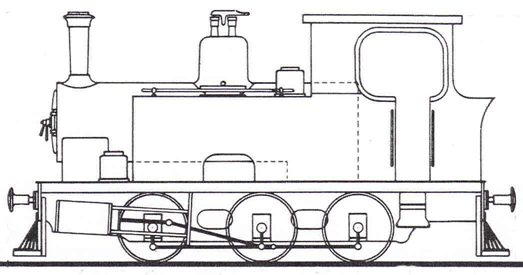
| Driving Wheels | 2ft 8in |
| Weight | 18ton 10cwt |
| Cylinders | Outside – 9in x 18in |
| Boiler Pressure | 160psi |
This locomotive was dispatched from Andrew Barclay at Kilmarnock in 1910 to work for Manawatu County Council to work on the Sanson Tramway. The locomotive was assembled on arrival in New Zealand at the Petone Railway Workshops in the Wellington region.
It carried the name Manawatu which is a river in the area which is said to have been named by Hau a Māori explorer.
The railways on New Zealand reached Manawatu in 1889 with the opening of the Wellington & Manawatu Railway between wellington and Longburn. In 1908 this became part of the North Island Main Trunk line which opened the inland districts by connecting the railway to Auckland.
The locomotive did not prove to be a success with the design of the firebox, the poor grade coal and inadequate maintenance all blamed for this. Various efforts were made to rectify the situation but none achieved a significant improvement. The Council eventually gave up and the locomotive fell out of use in 1925.
In 1929 the locomotive was sold to Thomas Borthwick & Sons of Paki Paki. It was employed there at the freezer plant which had opened in 1906. In 1931 the Napier earthquake destroyed the freezing works at Paki Paki.
Andrew Barclay supplied a new boiler for the locomotive in in 1931 and the locomotive was transferred to operate at the company’s Waingawa works near Masterton. The locomotive performed satisfactorily at the freezing works where it operated over short distances with few gradients.
In 1961 the boiler was declared life expired and the locomotive was converted to being a diesel engine by A&G Price of Thames who had started building locomotives in New Zealand in 1882.
In 1989 the Waingawa works was taken over by the Auckland Farmers Freezing Co (AFFCo) and two years later the locomotive was transferred to the AFFCo works at Wairoa. It continued to run there until around 2000 by which time it was the last active Andrew Barclay steam locomotive in New Zealand.
After being withdrawn the locomotive was displayed for a few years on a short length of track in Nuhaka.
In 2005 the locomotive was donated to the Rotorua Ngongotaha Rail Trust and it was displayed in their museum.
The converted locomotive is now at the Ngongotaha Rail Trust awaiting restoration.
Preserved Outside Britain – By Country
 Preserved British Steam Locomotives