| Weight | 33t |
| Driving Wheels | 3ft 0½ins |
| Boiler Pressure | 160psi |
| Cylinders | Outside – 12¼in x 16in |
| Tractive Effort | 8,420lbf |
This locomotive was built by Avonside Engine Company in Bristol in 1878 as one of a batch of 18 supplied to become the R class on the New Zealand Railway (NZR).
The locomotives were built using the Fairlie design of articulated locomotives that had the driving wheels on bogies and many were built as double ended.
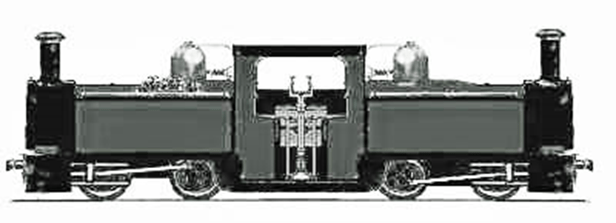
The Fairlie patent was developed by the Scottish engineer Robert Fairlie in 1864. The aim of his design was to put the weight of the locomotive on the driving wheels to maximise the tractive effort. The design also allowed the locomotives to drive in both directions without needing to be turned.
The R class locomotives were designed using the Fairlie patent but only had one bogie and was single ended. The need to be single ended resulted from the need to be capable of covering long distances through rough country with many small, short steep grades and tight curves. As a result, the requirement of the R class was for locomotives with larger coal bunkers and water tanks which required a trailing tender to be attached. The result is a locomotive that can negotiate tighter track curves whilst having greater stability to be achieved on the 3ft 6in gauge railway. They were capable of speeds of 50mph.
This locomotive (R28) entered service at Dunedin in May 1879 but from 1907 it was used at the Port of Lyttelton in Christchurch
In March 1907 it coupled up to the rear of an express train of twenty one carriages at Lyttelton to move the empty stock. The engine did not stop at its usual place but continued and ended up with half of the locomotive projecting over the end of the wharf. The bogie and cylinders dropped into the water leaving the boiler projecting some eighteen to twenty feet over the water. The locomotive was prevented from falling into the water as it was still attached to the coaches. The driver and fireman then blow off the steam and threw out the fire. The engine was fastened to the wharf overnight with ropes and chains until it could be rescued by a crane lifting the locomotive whilst two other engines hauled from the other end of the train. Some further parts fell into the water during this operation. The general theory was that there had been a problem with the brakes.
In 1912 the locomotive was once again based in Dunedin.
In 1915 the locomotive was fitted with a new boiler at the Hillside Railway Workshops in Dunedin. The new boiler had been built at the Addington Railway Workshops at Christchurch. After this it entered service again at Oamaru.
The locomotive returned to Christchurch and Lyttelton in 1922.
In 1934 the locomotive was taken out of service with the NZR. And sold to the Timaru Harbour Board where it worked until 1940.
In 1944 the locomotive was sold to the Morris family to work at Burkes Creek Colliery at Reefton.
In 1947 the engine was purchased by the State Mining Department to work at the Burkes Creek Collierty. It only worked there until the following year when it was withdrawn from service. It was then abandoned adjacent to the Burkes Creek line it previously ran on.
In 1960 the station master at Reefton attempted to save the locomotive for preservation. Later that year it was gifted to Inangahua County Council (ICC) on behalf of the people of Reefton.
Also in 1961 the locomotive was moved to the Reefton playground where it remained until 1982 when it was re-located near the centre of Reefton where it was under cover.
When the ICC was dissolved in 1987 the locomotive came under the ownership of the Buller District Council (BDC).
In 2005 a decision was taken to restore the locomotive which resulted in work over the next few years to assess the state of the locomotive and the work required to restore it.
In 2015 arrangements were made to purchase a boiler from classmate R22 for the locomotive. The locomotive is currently being restored by the Single Engine Fairlie Restoration Project Group at
Preserved Outside Britain – By Country
 Preserved British Steam Locomotives