| Weight | Locomotive – 241t 17cwt Tender – 50t 9cwt |
| Length | 93ft 10ins |
| Driving Wheels | 4ft 6ins |
| Boiler Pressure | 200psi Superheated |
| Cylinders | Four Outside – 20½in x 26in |
| Tractive Effort | 60,700lbf |
| Valve Gear | Walschaert |
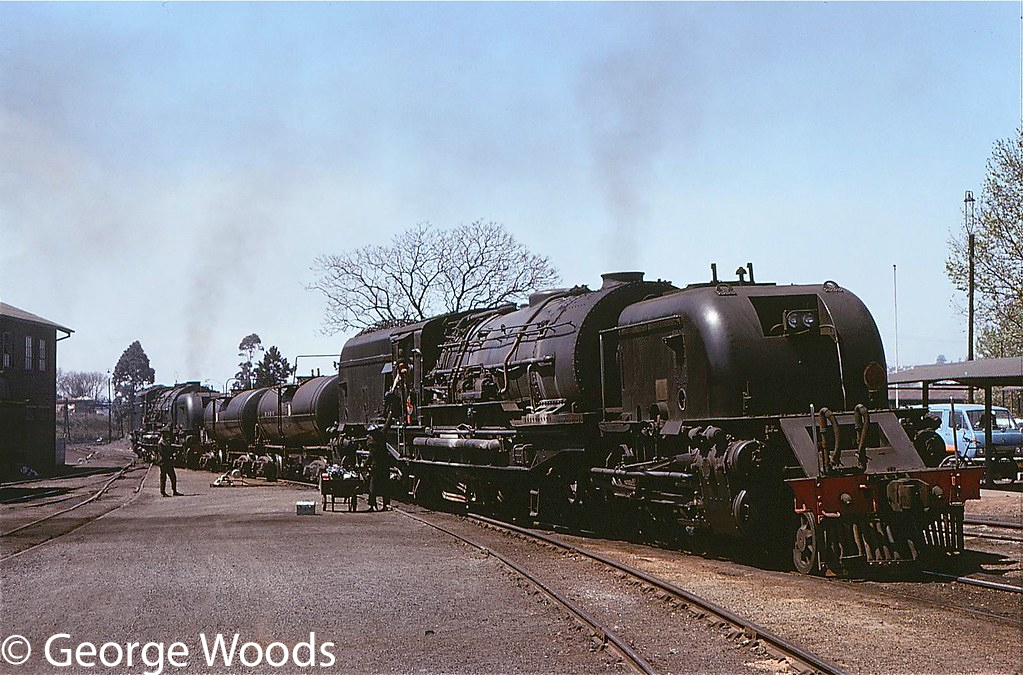
Between 1954 and 1958 120 class GMA Garratt articulated steam locomotives entered service with the South African Railways (SAR). The locomotives could be configured as either a class GMA branch line or GMAM mainline engine.
For details of class GMA and GMAM go to Class GMA and GMAM.
This was the most numerous Garratt class in the world and was a development of the GM class branch line locomotive introduced in 1938. Like the Class GM, the Class GMA was a tank-and-tender Garratt which ran with a semi-permanently coupled auxiliary water tender to augment its meagre water capacity.
The GMA class was designed in 1952 under the supervision of L.C. Grubb who was the Chief Mechanical Engineer of the SAR from 1949 to 1954. The first 25 locomotives (4051 -4075) were built by Henschel and Son in Germany in 1953 and entered service in the following year.
A second batch of 35 locomotives was delivered by Beyer, Peacock and Company (BP) in 1956. 23 (4076 – 4098) were made by BP and 12 (4099 – 4110) were subcontracted to the North British Locomotive Company (NBL). Interestingly the 12 locomotives carried works plates from both BP and NBL.
A third batch of 60 locomotives was delivered by BP in 1958. Only 10 of these (4121 – 4130) were made by BP. The other 20 (4111 – 4120 and 4131 – 4140) were built by NBL under sub from BP but like the earlier engines carried plates of BP and NBL. 4140 (BP 7855, NBL 27792) was the last steam locomotive built by NBL. The other 30 locomotives were built by Henschel.
The light rail branch line Class GMA and the mainline Class GMAM were the same locomotive of which the water and coal capacities could be adjusted to suit by installing or removing plates in the coal and water spaces. As a result, it is virtually impossible to list the GMA and GMAM versions separately since they could easily be converted back and forth between the two versions and often were. The details above are for the GMAM configuration.
The locomotive was thoroughly modern in design, with a one-piece cast steel frame with Franklin spring-loaded wedge horns, manufactured by Commonwealth Steel Castings Corporation in the United States of America. The locomotive was superheated and had a mechanical stoker and Walschaerts valve gear. It could negotiate curves of 275 feet radius.
The locomotives carried water in the front tank which had a capacity of 1,650 gallons for GMA engines or 2,100 gallons for GMAM engines. The rear bunker only carried coal with the GMA having a capacity of 11 tons 12 cwt and the GMAM engines 14 tons. The water capacity was augmented by a semi-permanently coupled purpose-built auxiliary water tender.
The GMA and GMAM class locomotives were employed on main- and secondary lines in many parts of South Africa. Prior to electrification.
A number were employed in Transvaal on the Komatipoort line across the pass between Waterval Onder and Waterval Boven. GMA locomotives also worked on the line from Krugersdorp via Zeerust to Mafeking.
They also served temporarily on the coal line from Witbank to Germiston until the electrification between Witbank and Welgedag was completed.
The second and third batches of locomotives were ordered from 1956 to assist with moving large volumes of traffic, mostly coal, from the Transvaal to destinations in the Free State and Cape Province.
Until they were replaced by diesel locomotives in 1958 they were employed on block coal workings from Witbank to Kroonstad, a distance of 208 miles. Since the track en route was built for 21 tons axle loads, such a large order for locomotives with a much lighter axle loading was unusual.
In Natal, the bulk of the Class was based at Pietermaritzburg, from where they worked most trains on the two heavily graded branch lines to Greytown and Franklin. Others worked on the Natal North Coast line between Stanger and Empangeni, while some joined the Class GL on the coal line between Vryheid and Glencoe.
The Cape Western system’s locomotives were stationed at Worcester, from where they worked the old New Cape Central Railway (NCCR) line via Riversdale to Mosselbaai until it was dieselised. Between 1981 and 1984, a number were allocated to the Cape Northern system to work the line from Vryburg to Mafeking. This turned out to be their last term in mainline service since they were replaced 1984 when the line was relaid with heavier rail.
Most of the class was then allocated to the Cape Midland System in 1984, with most of them initially stationed at Voorbaai. Here they hauled trains from Mosselbaai to Riversdale and across the Montagu Pass to Oudtshoorn. Their allocation was later extended to the sheds at Sydenham in Port Elizabeth, Rosmead, Klipplaat and Graaff-Reinet, with the result that they worked most of the trains over the route from Port Elizabeth to Rosmead via Klipplaat and across the Lootsberg Pass from Graaff-Reinet.
Towards the end of their service lives, the Eastern Transvaal system still had an allocation of them, where locomotives from the Waterval Boven and Breyten sheds worked the line down to Vryheid in Natal.
They were the last class of Garratt to remain in service with the SAR. All but three were withdrawn from service by April 1988 and those three were also retired shortly afterwards.
During the period from August 1979 to September 1981, altogether 26 of the locomotives were hired to Zimbabwe-Rhodesia, but not all at the same time since they were rotated with Capital Park in Pretoria as their nominal home for the occasions when they had to return to South Africa for major repairs. On the Rhodesia Railways (RR), later the National Railways of Zimbabwe, they worked from Bulawayo to Gwelo and to Wankie and beyond to Victoria Falls.
Six of these locomotives were loaned by RR to the Caminhos de Ferro de Moçambique (CFM) for a short while to work the CFM Centro line from Beira to Umtali in Zimbabwe.
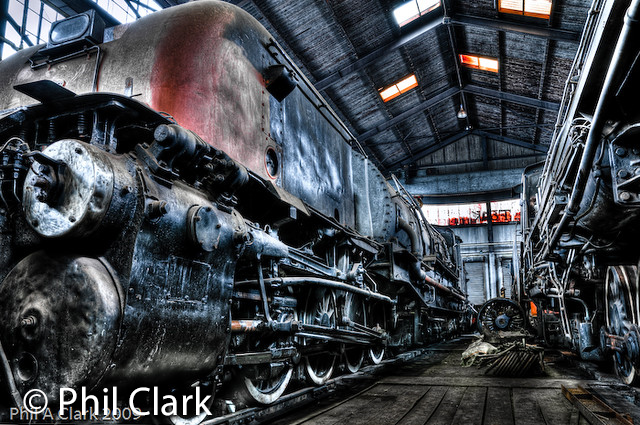
This locomotive (SAR 4083) was built by Beyer Peacock in Manchester in 1956.
In 1989 was sold and was then employed on the Enyati Colliery Railway at Vryheid in Nata. It remained there until 1993 when it was to be found at the Randfontein Estates Gold Mine near Johannesburg.
There were 12 ex South African Railways GMAM class locomotives in use at the mine until early 1995 when they were replaced by diesel engines.
In 1995 the locomotive was purchased by Ian Welch in operating condition.
The locomotive was rebuilt at Dunn’s Engineering using the power unit of classmate 4088 but this was later found to be bent and replaced with that from 4126. The rear unit of the locomotive was previously on 4088. The locomotive retains the 4083 number because this relates to the boiler cradle.
It was then shipped to Auckland where it arrived in August 1996. The locomotive was steamed on two open days at Parnell.
Work then commenced to convert the locomotive to using oil as a fuel and fitting an air brake. This work stalled due to the work on other locomotives having a higher priority and the reality that the locomotive was too large for the New Zealand loading gauge.
The locomotive is currently stored at the Mercer site of Mainline Steam.
A number of locomotives built by North British Locomotive Company and Beyer Peacock have been preserved in South Africa. There are also some built in Germany by Henschel and Son in Germany but they are not included. North British works number 27770 is preserved in Britain.
The following are preserved in South Africa
Beyer, Peacock and Company
- Works number 7677 – 4079
- Works number 7837 – 4122
- Works number 7843 – 4128
North British Locomotive Company
- Works number 27772 (BP works number 7829) – 4114
- Works number 27787 (BP works number 7850) – 4135
- Works number 27788 (BP works number 7851) – 4136
Back to Preserved Outside Britain – By Country
 Preserved British Steam Locomotives