The number range above excludes the locomotives built by the Montreal Locomotive Works (MLW) in Canada and entered service as class 14C engines.
Class 14 1701 – 1745
| Weight | 141 17cwt |
| Driving Wheels | 4ft 0ins |
| Boiler Pressure | 190psi superheared |
| Cylinders | Outside – 22in x 26in |
| Tractive Effort | 37,360lbf |
| Valve Gear | Walschaerts |
The details above are for class 14 locomotives as originally built.
The class 14 locomotive was a development of the class 12 and was similar enough to it that many components were interchangeable. It was ordered from Robert Stephenson and Company in 1913 and was delivered in three batches between 1913 and 1915.
At the time the class 14 was designed by D.A. Hendrie, Chief Mechanical Engineer (CME) of the South African Railways (SAR), it was believed that small differences in wheel diameter had disproportionate effects on performance.
The locomotives were shipped in a dismantled state and erected at one of the SAR Shops. They were then steam-tested and painted before being released into traffic. Because of the workload on the Durban workshops the assembly work was contracted to Messrs. James Brown and Company of Congella.
The Class 14 had Walschaerts valve gear and a Belpaire firebox and was superheated. It was delivered with Type MP1 tenders, which had a coal capacity of 10 tons and a water capacity of 4,250 imperial gallons.
From 1935, all the class 14 locomotives were reboilered with Watson Standard no. 2 boilers and reclassified to class 14R. In the process, the engines were also equipped with Watson cabs with their distinctive slanted fronts, compared to the conventional vertical fronts of the original cabs. Only slight modifications were found necessary to take the new boilers, such as a cast packer under the smokebox saddle and a widening of the running board below the cab. The flangeless leading coupled wheels were flanged and Type MR tenders were attached to the reboilered engines.
Their original Belpaire boilers were fitted with Ramsbottom safety valves, while the Watson Standard boiler was fitted with Pop safety valves.
The locomotives were placed in service on the mainline between Durban and Ladysmith in Natal. With the gradual further electrification of the Natal mainline in the later 1920s, they were eventually left to operate on the old mainline route via Botha’s Hill until that line was also electrified. Most of them were then allocated to Empangeni in the north and Port Shepstone in the south.
These were the most numerous, useful and ubiquitous class of steam locomotive to see service in Natal. They all gave more than 60 years of service, of which more than half was on the Natal mainline as a class 14 and then 14A locomotive. In 1976, many were transferred to the Witwatersrand for shunting service. By 1983, they were all withdrawn from service.
As a result of the collapse of railways during the civil war in Mozambique in the late 1970s, class 14R locomotives became the mainstay of locomotive power in Swaziland until they were eventually replaced there by class 15AR locomotives.
Similarly, while Rhodesia /Zimbabwe was rebuilding its Garratt fleet, eleven class 14R locomotives were hired for shunting service in 1981/82 to release Garratt locomotives for mainline work.
Thirteen class 14R locomotives were eventually sold into industrial service:
- 1701 became Apex Colliery no. 5 at Greenside.
- 1705 and 1737 became Grootvlei Proprietary Mines no. 5 Joyce and no. 4. No. 4 was later renumbered to no. 6 Graham.
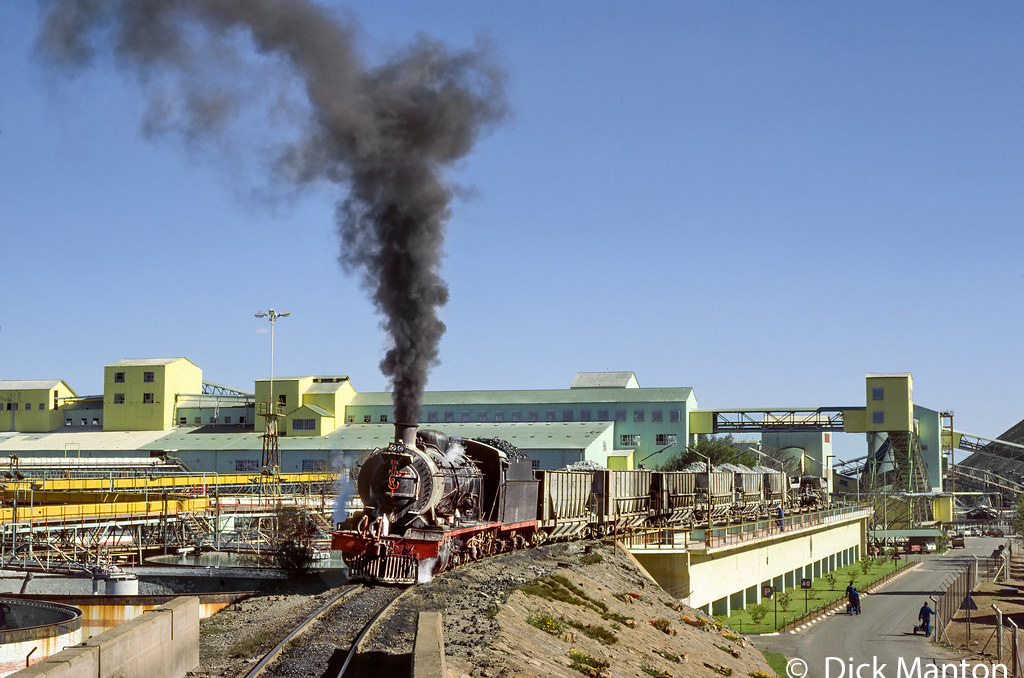
- 1711, 1714, 1719, 1732 and 1735 went to Rustenburg Platinum Mines
- 1723 and 1745 went to Natal Cambrian Colliery at Ballangeiech as no. 1 and 2
- 1729 went to the Vaal Reefs Gold Mine.
- 1730 became Randfontein Estates Gold Mine no. 5.
- 1740 went to Newcastle Platberg Colliery and later to Ballangeiech Colliery.
- – Class 14A 1576 – 1595, 1901-1914, & 1916-1921
- The details above are for class 14A locomotives as originally built.
- Following the success of the class 14, D.A. Hendrie, Chief Mechanical Engineer (CME) of the South African Railways (SAR), used its design as basis for the lighter class 14A locomotive for use on coastal lines, particularly the Cape Eastern line from East London where the physical conditions were approximately similar to those of the lower sections of the Natal mainline, but the permanent way was not as heavy. This second version of the class 14 was ordered from the North British Locomotive Company in 1913 and was built in two batches. Twenty (1576-1595) were delivered in 1914 and another 21 (1901-1921) in 1914 and 1915.
- Like the Class 14, the class 14A had piston valves, Walschaerts valve gear, a Belpaire firebox and was superheated, but it had nearly 6 inches less boiler diameter than the class 14 to reduce the axle loading from 16 long tons 3 hundredweight to 15 long tons. To compensate for the smaller boilers, they were equipped with smaller cylinders with a bore of 21 inches instead of 22 inches.
- The locomotives were erected at the East London workshops. Apart from their boilers and cylinders, the frame and other important components were standard with those of the class 14, such as the coupled wheels, bogie, Pyle National turbo-generators and headlamps, Hasler speed indicator, sight feed lubricators, Hendrie’s steam reversing gear, steam operation for rocking the firegrate, Gresham and Craven injectors, steam brakes and combination vacuum ejectors. It was also delivered with Type MP1 tenders which had a coal capacity of 10 long tons and a water capacity of 4,250 imperial gallons. One noticeable visible difference from the class 14 was the absence of the two large sandboxes on each running board.
- From the mid-1930s, all the class 14A locomotives except one (1915) were eventually reboilered with Watson Standard no. 2 boilers. In the process they were also equipped with Watson cabs with their distinctive slanted fronts, compared to the conventional vertical fronts of their original cabs. In spite of still being nearly 3 long tons lighter after reboilering, they were reclassified to class 14R along with reboilered class 14 locomotives instead of to class 14AR.
- As intended, the class 14A locomotives were placed in service on the East London mainline. Although they were good engines, they were not very successful there and were soon relocated to be shared between the Cape Western system for use between Cape Town and Beaufort West and the Eastern Transvaal system for use on the line to Delagoa Bay out of Pretoria, particularly between Waterval Boven and Komatipoort. The Cape Western’s engines later joined the rest of the Class in the Eastern Transvaal. They proved themselves as free steaming locomotives, low on maintenance costs and trouble-free, and therefore popular with crews and fitters alike.
- Six class 14R locomotives were eventually sold into industrial service:
- 1586 went to Rustenburg Platinum Mines, retaining its SAR number.
- 1589 became Bob at the Vaal Reefs Gold Mine.
- 1906 became Randfontein Estates Gold Mine no. 6.
- 1908 became Apex Colliery no. 4 at Greenside.
- 1918 went to St Helena Gold Mines.
- 1921 became Grootvlei Proprietary Mines Limited no. 3 Duggie.
- In 1915, the South African Railways placed fifteen class 14B saturated steam locomotives t in service. When they were subsequently converted to superheating, they were reclassified to class 14. In the 1930s all but one were reboilered with Watson Standard no. 2 boilers and reclassified to class 14R.
- The third version of the class 14 locomotive was ordered from Beyer, Peacock and Company in 1914. Fifteen locomotives were delivered in 1915, numbered in the range from 1746 to 1760. These saturated steam versions of the class 14 were designated class 14B.
- Like the class 14, the class 14B had Walschaerts valve gear and a Belpaire firebox. Because it was intended for use on the lower section of the Natal mainline, D.A. Hendrie, Chief Mechanical Engineer (CME) of the South African Railways (SAR), concluded that no high degree of superheat would be attainable and the locomotives were therefore ordered without superheaters. They were intended for use on the Town Hill section near Pietermaritzburg, where the old line was on a 1 in 30 gradient and where speeds were low with frequent stops which, it was reasoned, would not justify the use of superheating.
- Once in service, the omission of superheating soon became a bone of contention. About six years after the class 14B was commissioned, an officer of the Mechanical Department submitted a report which claimed that the loss of haulage power and increased water and coal consumption which were brought about by the absence of superheating on these engines, represented a loss to the SAR of approximately £100,000 when compared with the superheated class 14. Given that eight years later, in 1929, the purchase price of a new class 19A locomotive would be £6,387 this was a staggering amount.
- Between 1922 and 1925, all fifteen class 14B locomotives were fitted with superheaters. Their cylinders were reamed from 21 to 22 inches bore and the boiler pressure reduced from 200 to 190 psi. As a result of these changes the locomotives became the same as the class 14 engines tso they were reclassified as such..
- From 1935, all the ex class 14B locomotives except one (1750) were reboilered with Watson Standard no. 2 boilers and reclassified to class 14R. Only slight modifications were found necessary to take the new boilers. In the process, the engines were also equipped with Watson cabs with their distinctive slanted fronts, compared to the conventional vertical fronts of the original cabs. The flangeless leading coupled wheels were flanged and Type MR tenders were attached to the reboilered engines. No. 1750 was sold to ISCOR without being reboilered.
- Their original Belpaire boilers were fitted with Ramsbottom safety valves, while the Watson Standard boiler was fitted with Pop safety valves.
- The locomotives were initially in service on the lower sections of the Natal mainline, particularly the Town Hill section near Pietermaritzburg. After their reboilering and the electification of the Natal mainline, most were then allocated to Empangeni in the north and Port Shepstone in the south. In 1976, many were transferred to the Witwatersrand for shunting service. They were all withdrawn from service by 1983.
- Five class 14R locomotives were eventually sold into industrial service:
- 1750 became ISCOR no. 15 and later Enyati Colliery no. 3.
- 1754 and 1759 went to Rustenburg Platinum Mines, retaining their SAR numbers.
- 1755 became St Helena Gold Mines no. 7.
- 1757 was sold to Grootvlei Proprietary Mines Limited.
- Class 14C
- The details above are for class 14C locomotives as originally built.
- These locomotives were built by the Montreal Locomotive Works (MLW) in Canada.
- The locomotive design followed North American practice in many ways and their appearance was typically American, with high running boards and large cabs. They had bar frames, Walschaerts valve gear, Belpaire fireboxes and were superheated.
- As with other class 14 locomotives they were reboilered with Watson Standard no. 2 boilers and reclassified to class 14CR.
- Preservation
- Five British built class 14R locomotive have been preserved plus one (SAR 1908) that was built at the Montreal Locomotive Works (MLW) in Canada which was originally a class 14C locomotive
- Beyer, Peacock and Company Works No 5890 – SAR 1759
- North British Locomotive Company Works No 20568 – SAR 1576
- Robert Stephenson & Company Works No 3543 – SAR 1701
- Robert Stephenson & Company Works No 3560 – SAR 1718
- Robert Stephenson & Company Works No 3632 – SAR 1733
Back to Preserved Outside Britain – By Country
 Preserved British Steam Locomotives