| Weight | 129t |
| Driving Wheels | 4ft 3in |
| Boiler Pressure | 200psi |
| Cylinders | Outside – 19in x 26in |
| Tractive Effort | 27,600lbf |
| Valve Gear | Walschaerts |
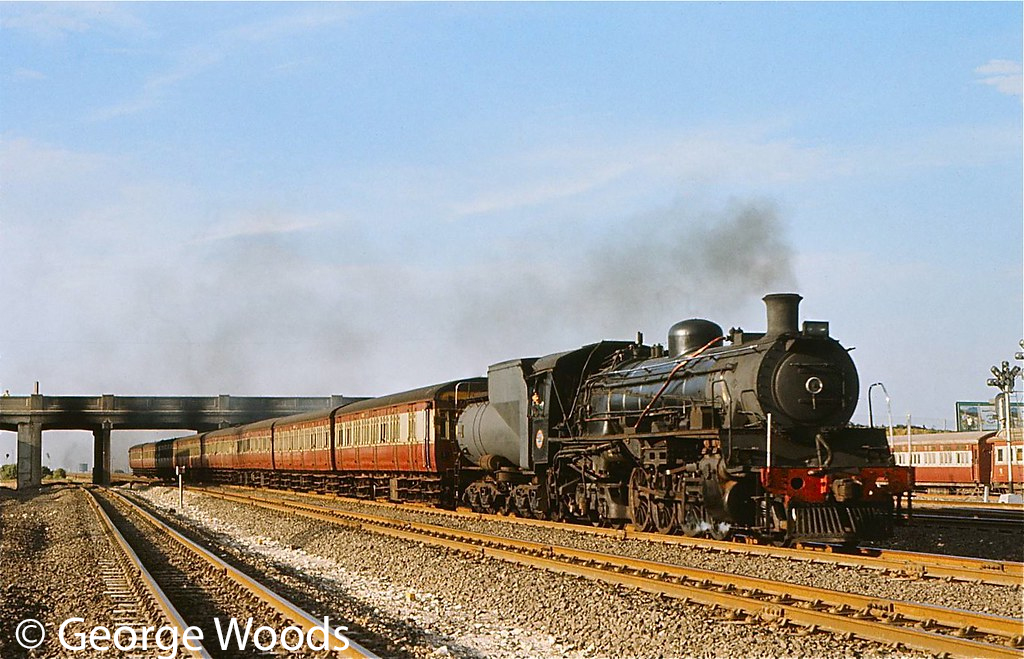
In 1948/50 the North British Locomotive Company in Glasgow built 100 locomotives which became the South African Railways (SAR) class 24. The cast engine main frames and the Buckeye bogies for the tenders were supplied by General Steel Castings of Eddystone, Pennsylvania.
The locomotives were designed by Dr. M.M. Loubser who was the Chief Mechanical Engineer of the SAR and were intended to replace older locomotives on branch line services on light rails.
The Class 24 had a one-piece cast-steel main frame which was cast integrally with the cylinders, including the cylinder hind covers, smokebox support frame, stays and various brackets, all of which would normally be separate items riveted or bolted onto the frames. They were the first South African steam locomotive to be built using this technique which aimed to reduce maintenance requirements and hence less time out of service.
They were built with Watson Standard boilers, while their double hopper type ashpans were specially designed to clear the four-wheeled trailing bogies. Their specially designed tenders, which rode on three-axle bogies to reduce the axle load, had cylindrical water tanks and were commonly known as torpedo tenders.
The locomotives were employed on branch line duties on light rails and 55 of them were based on the South West Africa System (now Namibia).
From some time between 1955 and 1959, they were also employed on the Keetmanshoop-Walvisbaai section. They remained in that territory until 1961, when strengthening of the track and the complete dieselisation of the South West Africa System made them available to be employed elsewhere.
Other branch lines to be served by the Class 24 include Breyten to Lothair, Nylstroom to Vaalwater, Port Elizabeth to Alexandra and George to Knysna. As a relatively powerful locomotive, they were also useful as suburban locomotives, a role they served in on the Springs-Nigel commuter line until electrification. Some eventually also worked on the Selati line in the Transvaal Lowveld. Heavy overhauls were done at Bloemfontein. The only province where they were unknown was Natal.
The locomotives were withdrawn from service in the 1980s.
Preservation
North British Locomotive Company – Works No 26318 3606
North British Locomotive Company – Works No 26320 3608
British Locomotive Company – Works No 26332 3620
North British Locomotive Company – Works No 26323 3611
North British Locomotive Company – Works No 26324 3612
orth British Locomotive Company – Works No 26332 3620
North British Locomotive Company – Works No 26343 3631
North British Locomotive Company – Works No 26344 3632
North British Locomotive Company – Works No 26345 3633
North British Locomotive Company – Works No 26347 3635
North British Locomotive Company – Works No 26350 3638
North British Locomotive Company – Works No 26357 3645
North British Locomotive Company – Works No 26359 3647
North British Locomotive Company – Works No 26366 3654
North British Locomotive Company – Works No 26367 3655
North British Locomotive Company – Works No 26376 3664
North British Locomotive Company – Works No 26379 3667
North British Locomotive Company – Works No 26380 3668
North British Locomotive Company – Works No 26387 3675
North British Locomotive Company – Works No 26400 3688
North British Locomotive Company – Works No 26401 3689
North British Locomotive Company – Works No 26402 3690


Back to Preserved Outside Britain – By Country
 Preserved British Steam Locomotives