| Weight | 60t 10cwt |
| Driving Wheels | 3ft 6ins |
| Boiler Pressure | 175psi |
| Cylinders | Two Outside – 18in x 22in |
| Tractive Effort | 22,280lbf |
| Valve Gear | Stephenson |
The first locomotive to be designed for the Natal Government Railways (NGR) by D.A. Hendrie the Locomotive Superintendent of the NGR in 1903 was a 4-8-2 tank locomotive. It was built by the newly established North British Locomotive Company (NBL) in the former Dübs shops in Glasgow.
Twenty-five of these locomotives were delivered in 1904, numbered in the range from 250 to 274. Until they were designated class E at some stage between 1904 and 1908, they were known on the NGR as the Dübs B or Improved Dübs, even though Dübs and Company had already ceased to exist when the locomotives were built, having been merged into the NBL.
When the Union of South Africa was established on 31 May 1910, the three Colonial government railways (Cape Government Railways, NGR and Central South African Railways) were united under a single administration to control and administer the railways, ports and harbours of the Union. Although the South African Railways and Harbours came into existence in 1910, the actual classification and renumbering of all the rolling stock of the three constituent railways were only implemented with effect from 1 January 1912.
In 1912, these locomotives were designated class G on the South African Railways (SAR) and renumbered in the range from 197 to 221.
The locomotives entered service working the mainline passenger Corridor Trains out of Durban, but they were soon replaced by the NGR class B 4-8-0 tender locomotives, Hendrie’s second locomotive design, which entered service later in 1904. They were then used as banking engines from Ladysmith up the Van Reenen Pass on the rail connection between Natal and Harrismith in the Orange River Colony. They remained in use there as well as in general service on some of the heavier branch lines until the loads became too heavy for them.
By 1944, six of them were still working in light shunting at various marshalling yards in the Union. The last pair were withdrawn from shunting service around Pietermaritzburg in 1962. Several were sold to mines and other industrial concerns.
It is said to believe that this type of locomotive hauled the train on which Ghandi was travelling to Pietermaritzburg as a passenger and was removed from the first class to the third class and inspired him to start his path to passive resistance.
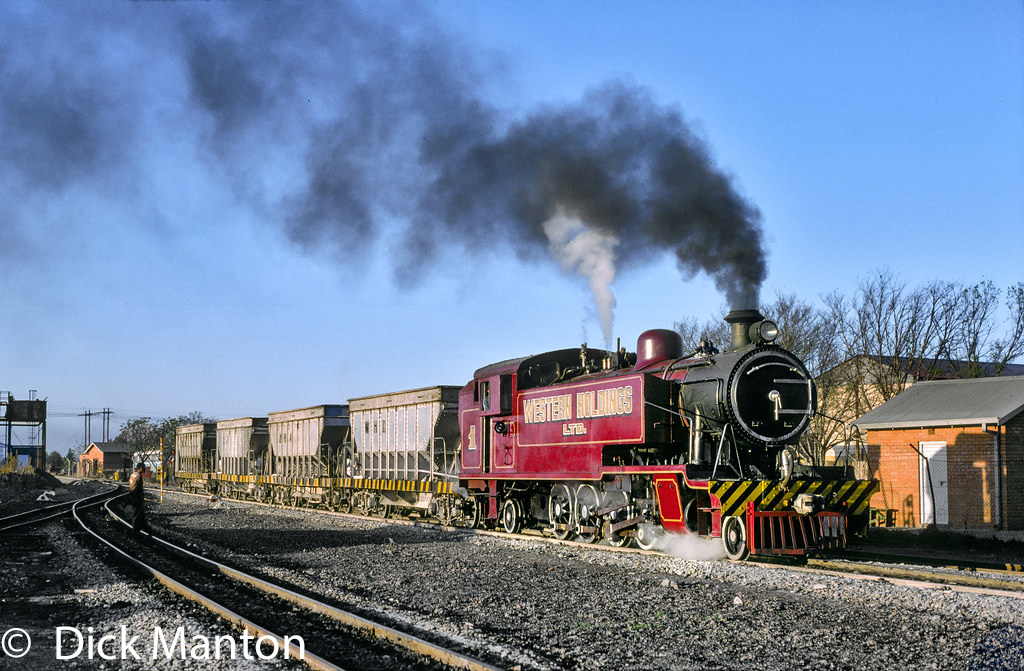

Preservation
North British Locomotive Company Works No 16084 – NGR 274 & SAR 221
Back to Preserved Outside Britain – By Country
 Preserved British Steam Locomotives