| Weight | Locomotive – 183t 18cwt |
| Length | 88ft 5ins |
| Driving Wheels | 4ft 0ins |
| Boiler Pressure | 200psi Superheated |
| Cylinders | Four Outside – 18½in x 26in |
| Tractive Effort | 55,620lbf |
| Valve Gear | Walschaert |
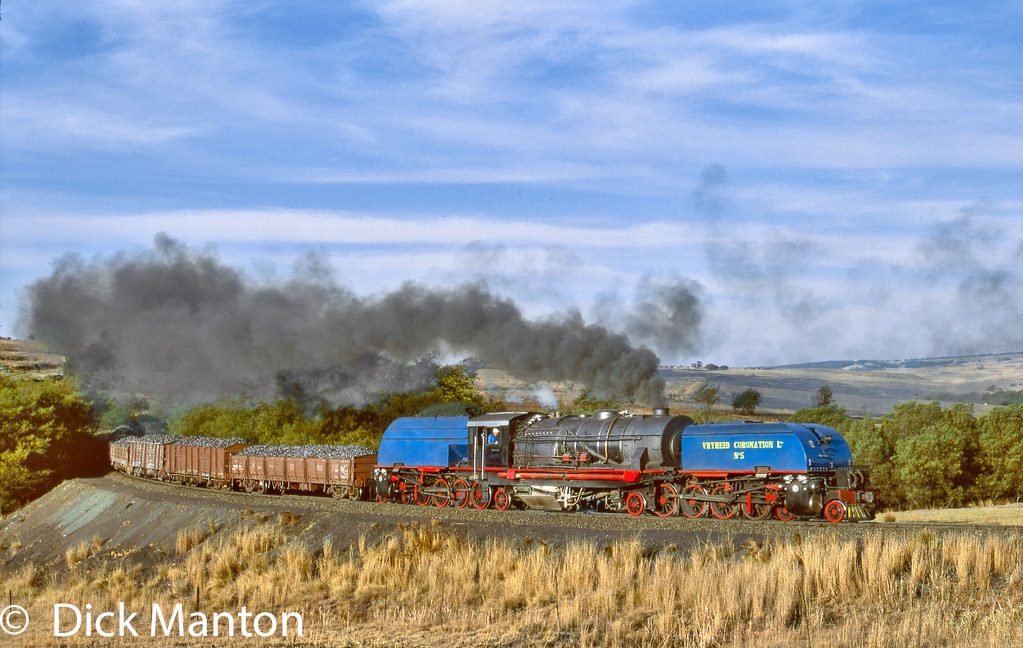
During 1946 and 1947 50 class GEA Garratt articulated steam locomotives entered service with the South African Railways (SAR). The locomotives were built by Beyer Peacock in Gorton, Manchester.
These were the first 4-8-2+2-8-4 Double Mountain type Garratt locomotive to be introduced into service on the SAR after the Second World War. It was designed by Dr. M.M. Loubser, Chief Mechanical Engineer (CME) of the SAR. Although it was a development of the GE class 2-8-2+2-8-2 locomotive, it bore little resemblance to the older locomotive.
It had a boiler which was designed to be interchangeable with that of the earlier Garratt model regarding external dimensions, but it had a bar frame and a round-topped firebox instead of the plate frame and Belpaire firebox of the earlier locomotive. They were the first South African Garratt locomotives to have streamlined water tanks and coal bunkers and its engine units were radically different from those of the earlier locomotives.
An order for fifty locomotives was placed with Beyer, Peacock and Company in 1945, the largest single Garratt order ever placed with them. When they were delivered during 1946 and 1947, they were erected at the Uitenhage workshops.
The locomotives were designed for goods traffic on light 60 pounds per yard rail on branch lines. Some teething troubles were experienced when they were first placed in service, but these were solved and they proved themselves as fine performers. They started their service lives working goods traffic on the lines from Johannesburg to Zeerust in the Western Transvaal.
In the Cape Province, they worked from Voorbaai to Oudtshoorn across the Montagu Pass and in the opposite direction to Riversdale. Some were later transferred to Natal to work on the North Coast line, based at Stanger and Empangeni, and on the Eshowe and Nkwalini branches. They also worked on the Franklin branch and the Overberg line from Cape Town across Sir Lowry’s Pass to Caledon.
In the Western Cape, wheatland fires caused by locomotives were a huge problem for farmers as well as for the SAR who had to pay out the claims. In the late 1960s an experimental spark-extinguishing equipment was fitted to one of the GEA locomotives (GEA 4009) and a class 19C engine. On 4009 the spark extinguishers were mounted on the chimneys and consisted of two long tubes to extend the exhaust horizontally. The tubes had spray pipes around the vertical outlet at the end to drench any sparks that may have survived the journey along the tubes. The tubes fed the exhaust forward to the outlet above the front end of the Garratt’s water bunker, which led to the engine being nicknamed Renoster (rhinoceros). The experiments were not successful.
The GEA class locomotives were all withdrawn from service by 1976.
Six of the locomotives were sold by the SAR into industrial service. Four (4003, 4020, 4024 & 4027) were purchased by Dunns Locomotive Works where they were overhauled and hired out. Two (4023 & 4031) were purchased to work at Vryheid Coronation Colliery.
Preservation
Beyer Peacock Works No 7170 – SAR 4003
Beyer Peacock Works No 7189 – SAR 4022
Beyer Peacock Works No 7190 – SAR 4023

Back to Preserved Outside Britain – By Country
 Preserved British Steam Locomotives