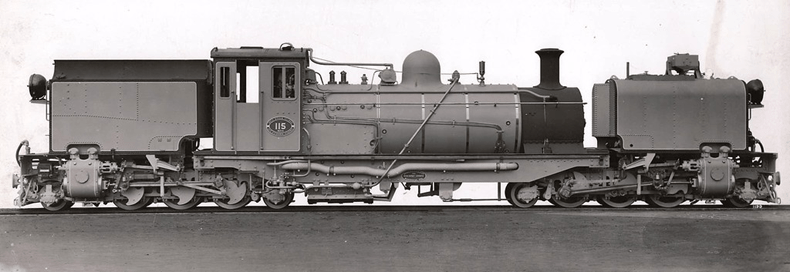
| Weight | 59t 2cwt |
| Length | 48ft 5¼ins |
| Driving Wheels | 2ft 9ins |
| Boiler Pressure | 180psi Superheated |
| Cylinders | Four Outside – 12in x 16in |
| Tractive Effort | 18,850lbf |
| Valve Gear | Walschaert |
Details above are for all except NG137-143.
In 1937, Société Anonyme John Cockerill of Seraing in Belgium delivered four new 2-6-2+2-6-2 locomotives, numbered in the range from NG85 to NG88, which were so similar to the older locomotives that they were initially designated class NG G13 as well. As all the carrying wheels were fitted with roller bearing axle boxes and arranged as swiveling pony trucks which was a difference from the earlier locomotives it was soon decided to reclassify them to class NG G16.
A second order of eight locomotives was delivered from Beyer, Peacock & Company in 1939. They were numbered in the range from NG109 to NG116.
The third order was for a further seven locomotives in 1951, numbered in the range from NG125 to NG131, once again from Beyer, Peacock. They still had elliptical tops on the water tanks and both tank and bunker were riveted as per the pre-war machines, however on the boiler the location of the safety valves, clack valves and main manifold (amongst other details) changed to what would become the standard for all remaining builds.
The fourth batch of seven locomotives, numbered in the range from NG137 to NG143, were the last steam locomotives to be built by Beyer, Peacock and were built to the specifications of the Tsumeb Copper Corporation in South West Africa (SWA). They were mechanically similar to the earlier and subsequent class NG G16 locomotives, but with a revised coal and water carrying arrangement. These locomotives had an enlarged front water tank capacity, but carried no water in their rear bunkers which consequently had a larger coal capacity. They had flat-topped water tanks with rounded top side edges, and were the first NGG16s to have welded tanks. It was planned to use them as tank-and-tender Garratts, semi-permanently attached to a water tender for use across the Namib desert in SWA, as was the practice with the Cape gauge (3ft 6in) locomotives.
However, while the locomotives were being built, the decision was made to convert all the SWA narrow gauge lines to Cape gauge. As a result of a prior agreement with the Tsumeb Copper Corporation, under which the South Africa Railways (SAR) would purchase any redundant narrow gauge locomotives if the re-gauging of the SWA system should take place, the locomotives were delivered directly to the SAR in 1958.
On the Avontuur Railway, these locomotives were used as tank-and-tender Garratts, but when the Langkloof members of the class were transferred to Natal in 1964, the water tenders were dispensed with since watering points were much closer together in Natal.
The final order for eight locomotives in 1967, numbered in the range from NG149 to NG156, turned out to be the last new steam locomotives to be ordered by the SAR. Beyer-Peacock had stopped building steam locomotives after the last batch of class NG G16 in 1958 and by 1968 they were in the process of closing the business altogether. Since no other overseas manufacturers were available to supply them, they were built by Hunslet-Taylor in Germiston using boilers supplied by their overseas principals, the Hunslet Engine Company in England. Built in 1967 and 1968, these locomotives had the same enlarged capacity front water tanks as those of the Tsumeb group, but their rear bunkers were identical to those of the 1951 batch of locomotives and carried both coal and water.
The locomotives built in Belgium (NG85 to NG88) remained in Natal for most of their service lives.
The Beyer, Peacock locomotives ordered by the SAR (NG109-116 and NG125-131) were deployed more or less equally between the Natal and Langkloof lines.
The seven Beyer, Peacock locomotives ordered by the Tsumeb Copper Corporation (NG137-143) were initially distributed between the Umzinto, Port Shepstone and Avontuur lines, but in 1964 the three that went to the Langkloof were also transferred to Natal.
The Hunslet-Taylor locomotives, numbers NG149 to NG156, were placed in service on the Harding and Donnybrook branches in Natal in 1968.
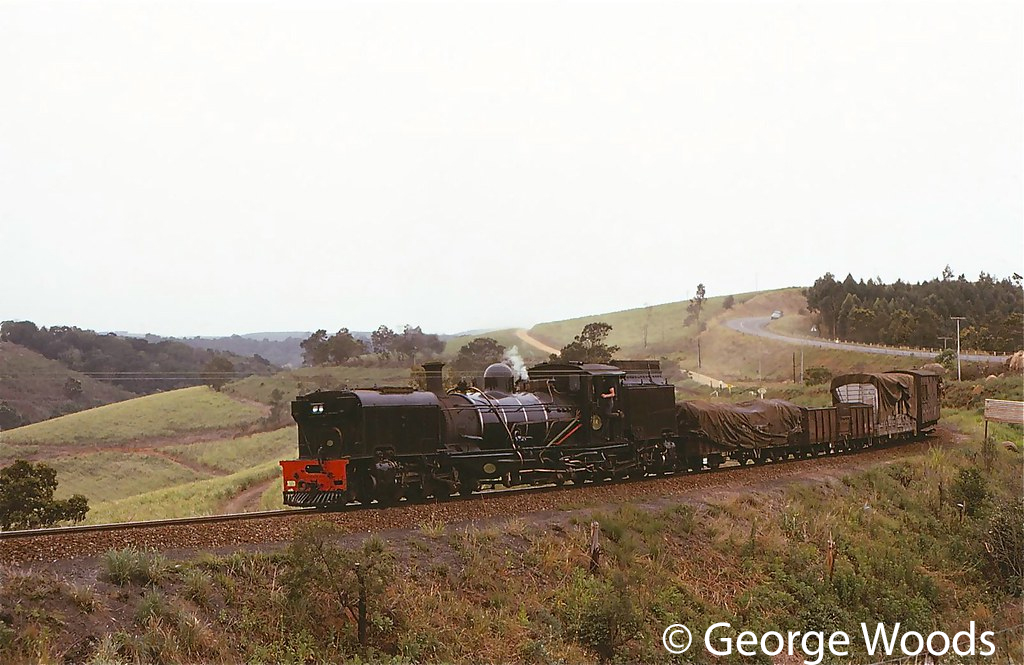
When the lower section of the Avontuur line was dieselised upon the arrival of the diesel-electric locomotives in 1973, all the class NG G16 locomotives still in service were transferred to various branches in Natal, where they remained until they were withdrawn from service.
When the four Natal narrow gauge systems were closed down by the SAR, the Weenen and Mid-Illovo lines were lifted, but the Harding line was privatised as the Alfred County Railway (ACR), operating out of Port Shepstone.
As part of their strategy to keep the railway competitive, two of the ACR’s Class NG G16 locomotives were rebuilt using technology similar to that used in the Cape gauge Class 26 Red Devil. The rebuilding incorporated a gas producing combustion system (GPCS), Lempor exhausts, an improved spark arrester, lightweight multi-ring articulated piston valves, improved valve events and improved mechanical lubrication. The two locomotives which received this treatment, no. NG141 in 1989 and no. NG155 in 1990, were reclassified to class NG G16A.
In comparative testing, no. NG141 achieved a fuel saving of 25% compared to a standard class NG G16 Garratt, a performance which was easily maintained in regular service. The cost of the work paid off financially within twelve months and led to a proposal to develop a class NG G17, but that never materialised since the line’s farming produce traffic was gradually lost to road transport on the improving road network.
Preservation
Since withdrawal from SAR service, some locomotives were sold to foreign railways and into private hands and restored to operational condition, while others ended up in various degrees of preservation ranging across the spectrum from running order to staging to total abandonment.
- The Welsh Highland Railway in Wales has five class NG G16 locomotives. One (NG140) is used as a source of spare parts while four locomotives, Cockerill-built no. NG87 and Beyer, Peacock-built numbers NG130, NG138 and NG143, are used for operational purposes.
- The Sandstone Estates near Ficksburg in the Free State is home to a large number of class NG G16 locomotives, either as the owners or as the custodian for locomotives belonging to individuals or other establishments. Three of their class NG G16 locomotives are homed there, and are regularly run during the Estate’s annual events.
- The Puffing Billy Railway, located in the Dandenong Ranges east of Melbourne, Australia, purchased NG129 in August 1996 and have completely rebuilt it, including re-gauging it to 2 ft 6.The Puffing Billy Railway also purchased NG127 in November 2011 which gave them a second almost-complete locomotive which will possibly also be totally rebuilt in the future.
Beyer Peacock Works No 6919 – NG109
Beyer Peacock Works No 6920 – NG 110
Beyer Peacock Works No 6921 – NG 111
Beyer Peacock Works No 6922 – NG 112
Beyer Peacock Works No 6923 – NG 113
Beyer Peacock Works No 6925 – NG 115
Beyer Peacock Works No 6926 – NG 116
Beyer Peacock Works No 7428 – NG 127
Beyer Peacock Works No 7429 – NG 128
Beyer Peacock Works No 7430 – NG 129
Beyer Peacock Works No 7431 – NG 130
Beyer Peacock Works No 7432 – NG 131
Beyer Peacock Works No 7862 – NG 137
Beyer Peacock Works No 7863 – NG 138
Beyer Peacock Works No 7864 – NG 139
Beyer Peacock Works No 7865 – NG 140
Beyer Peacock Works No 7866 – NG 141
Beyer Peacock Works No 7868 – NG 143

Back to Preserved Outside Britain – By Country
 Preserved British Steam Locomotives