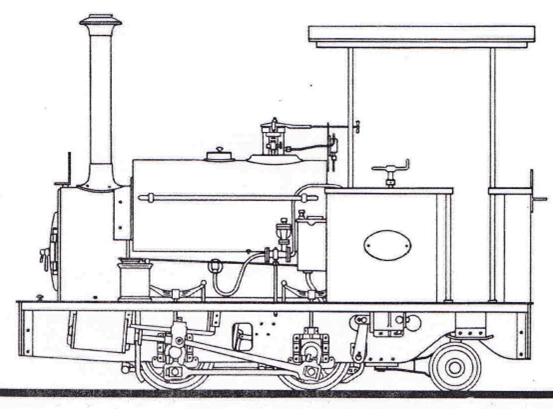
| Weight | 2t 4cwt |
| Driving Wheels | 1ft 8ins |
| Boiler Pressure | 180psi (Restricted to 150psi in use) |
| Cylinders | Outside – 5in x 10in |
| Tractive Effort | 1,500lbf at 150psi |
This locomotive was built in 1907 by Hudswell Clarke & Company in Leeds for the Coal Company of Glentunnel. It is only one of seven steam locomotives built by Hudswell Clarke to operate in New Zealand and one of the three such engines to be preserved.
The locomotive was ordered by John Deans of Homebush, Canterbury through a Dunedin based agent. Dean owned the Coal Company of Glentunnel which operated a brick works and coal mine.
Glentunnel was originally named Surveyors Gully but the name was changed in 1875 when the tunnel was constructed for a tramway to provide access to coal on the northern side of the hill. It is located in the Selwyn District of the Canterbury region of New Zealand’s South Island.
A horse tramway had existed there since the 1880s but the track was upgraded prior to the use of this locomotive there.
Although the locomotive is believed to have been a 2 ft 6in gauge engine it has been suggested that at some stage it was converted to work on a 2ft gauge railway.
In 1916 the locomotive was acquired by Nightcaps Coal Company at Nightcaps. Nightcaps was a settlement developed from 1880 to exploit the massive coalfield
The Nightcaps Coal Company built its own railway and produced some 1.8 million tonnes of coal, mostly low-grade lignite from underground mines. It operated for over 40 years before the mines were exhausted and miners shifted to nearby Ōhai where coal had been discovered in the 1870s. The name was possibly given because the tops of the Takitimu Mountains, which were often snow-capped, could be seen from the little township.
Coal production boomed in the area in 1882 when a private spur railway line was built by the Nightcaps Coal Company from the terminus of the New Zealand Government Railways Wairio Branch at Wairio to Nightcaps to provide more efficient transport of coal.
In 1916 a proposal was made to build another line to coal interests around Ohai. The construction of this line was fiercely opposed by the Nightcaps Coal Company, fearing a loss of business. The Ohai Railway Board (ORB) was formed with the backing of local government but central government declined to extend the line. The ORB line from Wairio to the new coalfields at Ohai with a deviation through Morley Village which was considered to be part of Nightcap. The line was approved in July 1919 and was largely funded by farmers. The first section of the line including the part servbing Morley Village opened in September 1920 with Ohai was reached four years later.
The Nightcaps Coal Company ceased to operate, and they handed over their railway line to the Railways Department, who dismantled it in 1926 as the Ohai branch line was capable of catering for traffic from Nightcaps.
In 1924 the locomotive was purchased by the Black Lion Coal Company. The Black Lion Mine was formerly known as the Ohai Mine started by the Nightcaps Coal Company The locomotive was used until some time in the early 1930s after which it was left idle until around 1945.
The following is taken from the Otago Daily Times published in May 2014.
The rusted remains of an old steam locomotive built in 1907 were unearthed when Solid Energy was working on a new coal-mining area at Ohai recently.
The remains of the locomotive, belived to be a Hudswell Clarke, built in the United Kingdom, were uncovered at the site of Ohai’s old Wairaki No1 underground mine while the state-owned coal miner was stripping the overburden in preparation for mining the coal.
Solid Energy Southland mine manager Antony Stodart said the narrow-gauge engine was probably dumped and buried in the 1940s.
Records showed the engine’s boiler was inspected and originally registered in Canterbury, with the machine working at Glentunnel, Canterbury, for the Homebush Coal Co, Mr Stodart said.
It was sold to the Nightcaps Coal Co in 1916, where it was used until the company’s operations ended in 1923. It was then sent to the Black Lion Coal Co in Ohai in 1924 and was known to have worked into the early 1930s. No decision had been made about the machine’s fate, he said.
”We have what we think is an original photograph of the machine, with the name Dunedin on it, so it would be good if a local organisation was interested in restoring it,” Mr Stodart said.
”As far as we can tell, the only New Zealand example of a restored Hudswell Clarke is Oamaru Steam and Rail’s 1924 engine.
”It would be good if someone was able to restore it because, as well as making steam engines, Hudswell Clarke made a lot of other mining equipment, so there’s a strong industry connection.”
In 2014 the remains of the locomotive were recovered and in December of that year they were taken to the Westland Industrial Heritage Park at Hokitika.
Preserved Outside Britain – By Country
 Preserved British Steam Locomotives