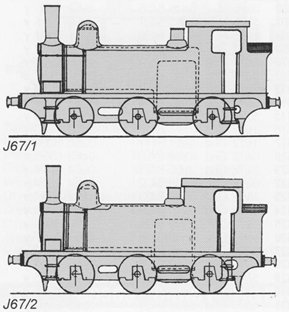

| J67 | J69 | |
| Power Classification | 2F | 3F reclassified 2F in 1953 |
| Introduced | 1890– 1901 | 1902 – 1904 |
| Designer | Holden | Holden |
| Company | GER | GER |
| Weight | 40t 0cwt – J67/141t 8cwt – J67/2 | 40t 9cwt |
| Driving Wheels | 4ft 0ins | 4ft 0ins |
| Boiler Pressure | 160psi | 180psi |
| Cylinders | Inside – 16½in x 22in | Inside – 16½in x 22in |
| Tractive Effort | 16,970lbf | 19,090lbf |
| Valve Gear | Stephenson – (slide valves) | Stephenson – (slide valves) |
Before the appointment of James Holden as Locomotive Superintendent in 1885, the Great Eastern Railway’s (GER) policy was to use obsolete main line engines for shunting duties. By the mid-1880s these engines were clearly insufficient to handle the rapid development in freight traffic. Hence Holden’s first locomotive design for the GER was the class T18 0-6-0T shunter (LNER Class J66). The first was built in May 1886, and by 1886 a total of fifty had been built in five batches.
In 1918 E L Ahrons wrote the following in The Railway Magazine.
“When Mr Holden succeeded Mr Worsdell at the end of 1885 he promptly started to settle the shunting engine question. The deficiency was somewhat glaring; there were at the beginning of 1886 only 15 0-6-0 shunting and goods tank engines on a railway with a total stock of somewhat over 700 engines. The new shunting engines, with 4ft wheels and 16½in by 22in cylinders, began to pour out of Stratford for some time, and now there are about 230 of them in service. The old days of painful and laborious movements to and fro on the part of retired tender engines on half pay are now over as far as the Great Eastern is concerned”.
The J66 proved a very successful design and was used as a basis for all future GER 0-6-0T locomotives (classes J65, J66, J67, J68, and J69). The only variations in the individual classes were due to the intended work. All survived into LNER ownership, and locomotives of the same basic design were still being built in 1923 at Stratford.
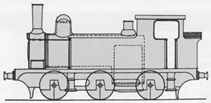 |
J66 introduced by Holden in 1886 for shunting work |
 |
J65 introduced by Holden in 1889 for light passenger duties. |
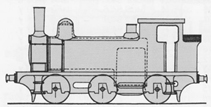 |
J67 introduced by Holden in 1890 designed for freight work |
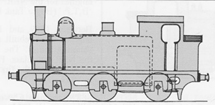 |
J69 introduced by Holden in 1902 designed for suburban passenger trains |
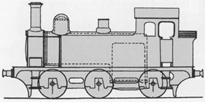 |
J68 introduced by Holden in 1912 as the final development of his 0-6-0T. |
Initially, all of the J66s were used for shunting work except for the eleven Westinghouse-fitted locomotives which were used to haul suburban passenger trains on the Enfield to Chingford line. The J66s on the Enfield services were replaced by J67s in 1890. Ten of these locomotives were relegated to shunting work, whilst 294 remained a passenger locomotive as it had previously been fitted with a Westinghouse brake in 1887.
Following the success of James Holden’s class T18 (LNER J66), further variations were built. The Class R24 was built between 1890 and 1901, and had a 6in longer wheelbase but a 6in shorter frame. The cab was slightly smaller and the side tanks were moved further forward. A total of 140 R24 locomotives were built, of which 100 were intended for passenger duties and were fitted with screw reverse gear and Westinghouse brakes.
From 1899, a standardised boiler was introduced for the R24 class. These operated at 160psi and were interchangeable with the boilers on the J65 and J66 locomotives.
With the advent of heavier rolling stock in 1902, a total of 95 R24s were rebuilt with 180 psi boilers between 1902 and 1921. Referred to as R24 Rebuilt, these locomotives had longer fireboxes with larger grates, and greater capacity side tanks.
In 1904, twenty Class S56 locomotives were built. These were intended for passenger work and were built with a 180psi boiler and high capacity side tanks.
As well as a Westinghouse brake, the passenger locomotives were fitted with screw reverse gear, balanced ten-spoke cast-steel wheels, and screw couplings. Most were also fitted with condensing gear. The shunting locomotives were fitted with a hand brake, lever reverse, unbalanced fifteen-spoke cast iron wheels, and three-link couplings. The hand brakes were later replaced with steam brakes.
At Grouping (1923), the LNER classified the 160psi locomotives as class J67. Class J69 was used for the R24 rebuilt and S56 locomotives.
During the 1920s, the LNER converted 59 of the J69s to be shunting locomotives by removing the condensing gear (where fitted), and fitting lever reverse gear. Steam brakes were also fitted although many locomotives kept their vacuum ejectors.
From 1938, a number of J69s had 160psi boilers fitted. They were classified as J67/2 distinguishing them from the original R24 locomotives with the small side tanks (class J67/1). At various other times different boilers were fitted and locomotives would be re-classified accordingly. From 1946, class J69 was given a similar division. J69/1 referred to large side tank locomotives, whilst J69/2 referred to locomotives with small side tanks.
The bulk of the J67s and J69s were allocated to Stratford, with 121 recorded as being allocated there at Grouping (1923). The GER operated the world’s most intensive steam operated suburban passenger service out of Liverpool Street Station and these locomotives performed very reliably on them.
Both passenger and shunting locomotives could also be found at Colchester, Ipswich, Cambridge, King’s Lynn, and Peterborough East. The passenger locomotives tended to be slightly more distributed across the GER sheds, and they could also be found at places like Norwich, Yarmouth, and Lowestoft. The Stratford passenger locomotives were mainly used on the ‘Jazz’ suburban services to Enfield Town and Chingfield. These were very intensive services that included relatively heavy commuter services. At the time no electric service was capable of handling the load, but these small steam engines handled the load very well especially when the relative lack of time for maintenance is taken into account.
All twenty locomotives built as class J69 engines passed to the LNER in 1923. Thirteen class J69 locomotives were lent to the War Department in October 1939, of which five had been built as Class S56. They were sold to the War Department in October 1940, where they were used on the Melbourne and Longmoor Military Railways. The remaining locomotives were renumbered 8617–8636 in order of construction; gaps were left where the locomotives sold to the War Department would have been.
In 1925, large numbers of N7 0-6-2T locomotives displaced many of the passenger J67s and J69s from the heavier duties. Hence they were moved to other parts of the LNER system to replace obsolete shunters. During the 1930s through to the 1950s, allocations were spread across the LNER system including sheds in Scotland. The only exception was the North East Area which had a good supply of shunting engines including new J72s. Many of the engines that stayed in the former GE area continued to operate as passenger pilots and for hauling occasional passenger services.
| |
J69 introduced by Holden in 1902 |
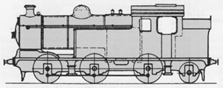 |
N7 introduced by Gresley in 1914 |
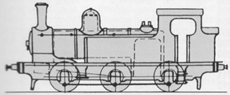 |
J72 class introduced on the NER by Worsdell in 1898 |
The first withdrawal was J69 7364. This was withdrawn in 1931 due to damage after a collision with J39 1265 at Northumberland Park. Withdrawals began in 1937 and twelve had been withdrawn by 1939.
| J67 (R24) | J69 (S56) |
Total |
||
| Built at Stratford | 1890-1901 |
140 |
140 |
|
| 1904 | 20 |
160 |
||
| Withdrawals | 1931 |
-1 |
-1 |
|
| 1937 |
-11 |
-11 |
||
| 1939 |
-1 |
-1 |
||
| Sold to War Dept | 1940 |
-8 |
-5 |
-13 |
| Converted to J69 |
-74 |
74 |
||
| Taken into BR stock | Jan 1948 |
45 |
89 |
134 |
Analysis of the 134 locomotives that were taken into BR stock
| J67/1 | This was Holden’s original design and were used for shunting and working local goods trains. |
35 |
| J67/2 | These were engines from 1937 onwards from J69 engines with lower pressure boilers and smaller fireboxes. These were also used for shunting and working local goods trains. |
10 |
| J69/1 | These were the original J69, but they were reclassified J69/1 in 1950 by BR. Introduced in 1902 they were a development of the J67 class with a higher boiler pressure, larger tanks and firebox. Some were rebuilt from J67’s. Most were fitted with air brakes and used in suburban and branch line passenger services. |
89 |
BR rebuilt ten locomotives from J67/1 with a higher boiler pressure and a larger firebox between 1948 and 1953 and they were classed as J69/2 engines.
Two engine (68529 and 68609) were reclassified from J67/2 to J69/1 in 1954 and 1952 respectively.
One engine (68517) that was taken into BR stock as a class J67/1 became a J69/2 in 1951 and then a J67/1 in 1953.
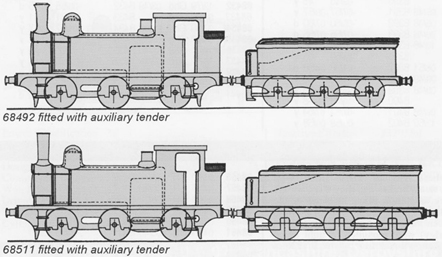
68492 was permanently coupled to a tender from a J36 class engine and 68511 to a J37 tender. They were based at Galashiels. Because of weight restrictions on the Lauder branch and on other branches in the Borders area they ran with side tanks empty to reduce their axle-load. Both were class J67/1 locomotives.
Number in Service under BR ownership.
|
J67 |
J69 |
Total |
|
|
End of Year |
No. in Service | No. in Service |
No. in Service |
| 1947 |
45 |
89 |
134 |
| 1948 |
44 |
90 |
134 |
| 1949 |
44 |
90 |
134 |
| 1950 |
39 |
95 |
134 |
| 1951 |
36 |
98 |
134 |
| 1952 |
34 |
100 |
134 |
| 1953 |
34 |
96 |
130 |
| 1954 |
30 |
96 |
126 |
| 1955 |
20 |
95 |
115 |
| 1956 |
11 |
92 |
103 |
| 1957 |
7 |
87 |
94 |
| 1958 |
0 |
62 |
62 |
| 1959 |
45 |
45 |
|
| 1960 |
31 |
31 |
|
| 1961 |
13 |
13 |
|
| 1962 |
0 |
0 |
Locomotive allocations during British Railways operation
|
Depots as at January |
1948 | 1952 | 1955 | 1958 | 1959 | 1960 | 1961 |
1962 |
| Boston |
4 |
3 | 8 | 5 | 4 | 2 |
2 |
|
| Brunswick |
2 |
1 |
2 |
|||||
| Bury St Edmunds |
2 |
1 | 2 |
1 |
||||
| Cambridge |
6 |
5 | 5 | 4 |
2 |
|||
| Canklow |
1 |
|||||||
| Carlisle Canal |
1 |
|||||||
| Colchester |
3 |
5 | 4 | 2 |
3 |
|||
|
Colwick |
1 |
3 | 5 | 2 | 5 | |||
| Dawsholm |
1 |
1 |
||||||
| Doncaster | 6 | 11 | 4 |
1 |
||||
| Dundee Tay Bridge | 2 | 1 |
1 |
|||||
| Dumfries | 1 |
1 |
||||||
| Dunfermline Upper |
1 |
|||||||
| Eastfield |
2 |
|||||||
| Gorton |
1 |
|||||||
| Grantham | 1 |
2 |
||||||
| Hatfield |
2 |
1 |
||||||
| Hitchin |
3 |
3 |
2 |
|||||
| Ipswich |
3 |
3 | 6 |
2 |
||||
| Kings Lynn |
8 |
7 | 6 | 7 | 2 |
5 |
||
| Kittybrewster | 2 | |||||||
| Langwith Junction | 2 |
2 |
||||||
| Leicester Central | 1 | |||||||
| Lincoln |
8 |
9 | 11 | 7 | 7 | 3 |
2 |
|
| Lowestoft |
2 |
1 | 1 | 2 |
1 |
|||
| March | 1 | 1 |
1 |
|||||
| Melton Constable |
1 |
1 | 2 |
2 |
||||
| Mexborough | 1 | 2 |
2 |
|||||
| New England |
3 |
1 | 3 |
1 |
||||
| Norwich Thorpe |
5 |
8 | 6 |
1 |
||||
| Parkeston |
4 |
4 | 1 | 4 |
2 |
|||
| Parkhead |
2 |
2 |
1 |
|||||
| Polmont |
3 |
3 | 2 | 1 |
1 |
|||
| Retford | 4 | 3 |
2 |
|||||
| South Lynn |
2 |
4 | 5 | 4 |
1 |
|||
| Staveley | 1 | 3 |
1 |
|||||
| St Margarets |
7 |
3 |
1 |
|||||
| Stratford |
47 |
51 | 45 | 32 | 18 | 16 | 11 |
11 |
| Thortnton Junction |
4 |
3 |
1 |
|||||
| Trafford Park |
2 |
4 | 1 |
1 |
||||
| Walton on the Hill |
1 |
1 |
1 |
|||||
| Widnes |
1 |
|||||||
| Wrexham Rhosddu |
1 |
3 | 4 |
2 |
||||
| Yarmouth South Town |
2 |
2 | 1 |
1 |
||||
| Yoker |
1 |
|||||||
|
134 |
134 | 126 | 94 | 62 | 45 | 29 |
11 |
|
| Service Department |
2 |
|||||||
|
31 |
- Birkenhead, Brunswick (Liverpool) and Wrexham Rhosddu were all places on the former Cheshire Lines Committee routes which served Birkenhead, Chester, Knutsford, Liverpool, Manchester, Northwich, Southport, Stockport, Warrington, Widnes and Winsford. It was the second-largest joint railway with 143 miles of track which was jointly used by the Great Northern Railway (GNR), the Manchester, Sheffield and Lincolnshire Railway (MS&LR) and the Midland Railway (MR). On Grouping in 1923 the MR became part of the London, Midland and Scottish Railway (LMS), the MS&LR (which had by then become part of the Great Central Railway) and the GNR became part of the London and North Eastern Railway (LNER). This resulted the allocation of LNER class J69 and J72 locomotives to Wrexham Rhosddu, Bidston and Birkenhead.
In the early 1950s locomotive 68619 was returned to its LNER numbering of E8619 and painted in GER blue for use at Liverpool Street Station as station pilot.
With the arrival of diesel shunters, withdrawals were quick. The last J67 was withdrawn in 1958, and the last J69 was withdrawn in 1962.
Preservation
 Preserved British Steam Locomotives