| Driving Wheels | 4ft 6ins |
| Weight | 109 tons |
| Boiler Pressure | 200psi |
| Cylinders | Outside – 18in x 26in |
| Tractive Effort | 24,960 lbf |
40 locomotives were built in 1939 by the North British Locomotive Company and became the J class. They were built by the North British Locomotive Company as the NZR workshops were already fully employed.
They were designed to provide a mixed traffic locomotive that was more powerful than the Ab class that was capable of running on the lighter secondary lines of the New Zealand Railways (NZR) network. They also had to be equally capable of running express passenger trains on main routes.
The J class incorporated roller bearing axles, hydrostatic lubrication and twin Westinghouse brake pumps.
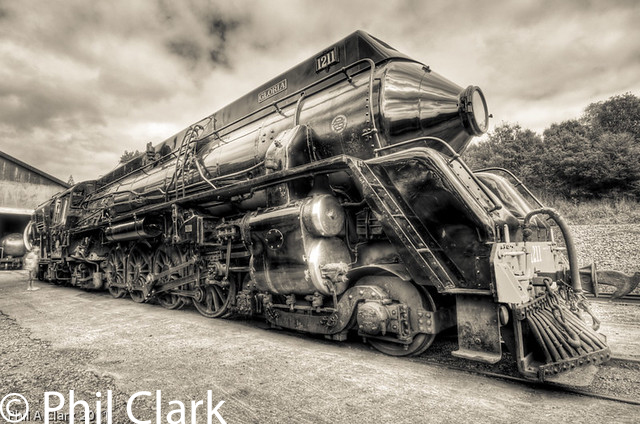
They had bar frames instead of plate frames and were equipped with Baker Valve-gear. The locomotives were attached to Vanderbilt tenders and were outshopped with distinctive bullet-nosed streamlining.
The first 30 of the class in service were allocated to the North Island, with the last 10 allocated to the South Island for use on the hilly section between Dunedin and Oamaru. They were immediately placed into service on the main trunk routes in both islands in order to help move wartime traffic during the Second Word War. Although used on freight trains as well, the class was well suited to high-speed running on the passenger trains of the era.
Due to the wartime conditions, the streamlining became burdensome for maintenance and the skyline casing, which was open at the top proved to be a trap for soot from the locomotive’s exhaust. After a time, the skyline casing started to be removed from some examples of the class leaving them with just the bullet nose. The design was successful enough that NZR opted to build an improved variant called the Ja class in its Hillside workshops from 1946.
After the Second World War the railway suffered from shortages of coal and 12 class J locomotives were converted to oil burning. The conversion saw the installation of a two-nozzle burner in the firebox, removal of the grate and ashpan which was replaced with a firepan lined with bricks, shortening of the superheater tubes in the boiler, removal of the spark arrester in the smokebox, removal of the brick arch, addition of the related controls and gauges for the oil burning equipment, and the tender modified to carry an oil bunker and associated steam piping.
This locomotive (J 1211) ran on the NZR from 1939 until 1971 when it was placed in store at Dunedin.
In 1972 the locomotive was purchased by three people for use with Steam Incorporated. It was later bought outright by one (Ian Welch) of the three. The locomotive acquired the name Gloria (after his wife) at some time.
After being leased to operate on the Bay of Islands Vintage Railway in 1985 the locomotive was moved to the Glenbrook Vintage Railway for an overhaul to mainline running. After this the locomotive hauled railtours on both Islands.
From 1986 locomotive was stored in Auckland until 1988 when it entered service again on the mainline.
In 1996 the locomotive was converted to oil burning.
Between 2013 and 2018 the boiler from the locomotive was overhauled before returning to service in December 2018.
The locomotive is based on the Glenbrook Vintage Railway.
There are two other preserved J class locomotives built by the North British Locomotive Company.
• Works number 24557 – J1234
• Works number 24559 – J1236 Joanne
Preserved Outside Britain – By Country
 Preserved British Steam Locomotives