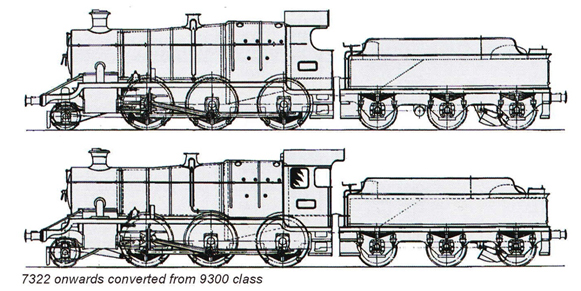
| Power Classification | 4MT |
| Introduced | 1911- 1932 |
| Designer | Churchward |
| Company | GWR |
| Weight – Loco | 62t 0cwt |
| Tender | 40t 0cwt |
| Driving Wheels | 5ft 8ins |
| Boiler Pressure | 200psi superheated |
| Cylinders | Outside – 18.5in x 30in |
| Tractive Effort | 25,670lbf |
| Valve Gear | Stephenson (piston valve) |
This was the first modern 2-6-0 design to be built in Britain and in part owe some of its origins to a visit made to Canada and the USA by Holcroft who worked in the drawing offices at Swindon. Churchward was looking to develop an inside-cylinder engine with 10inch diameter long-travel valves on top of the cylinders as he did not wish to perpetuate the double-framed eight-wheeled tender engines that were currently deployed for secondary work. The proposal was not working out well and he visited the drawing office to understand why. Churchward later returned and told Holcroft to design a 2-6-0 with 5ft 8in driving wheels and outside cylinders and a standard Swindon No 4 boiler plus as many other standard parts as possible. The result was the 4300 class.
They were thus designed from standard GWR locomotive parts already available and they were virtually a tender version of the 3150 class. To reduce the overall length of the engines Saint class cabs were used which was the shortest that could be used. This enable the locomotives to have the maximum availability on lines where short turntables might limit their use. After the first twenty had gone into service the running department found that the layout of the injector gear was somewhat cramped and they would rather lose a little availability to provide more space for the injectors. After the first twenty the cabs were 9in longer as the County class cab design was incorporated in the locomotives.
324 locomotives were built. The first being withdrawn in 1936 (for conversion to 6800 and 7800 classes). They were very successful mixed traffic locomotives, being used on semi-main line passenger work and on cross-country routes.
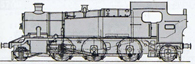 |
3150 class introduced in 1906 as a development of the 3100 class with a larger boiler |
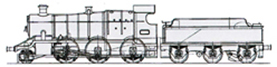 |
4300 class as introduced in 1911 |
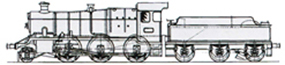 |
4300 class as converted from the 9300 class (7322-7341) |
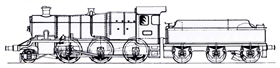 |
9300 class introduced in 1932 |
Over the years there were many detail alterations such as different types of chimney, alterations to the frame length at the rear and many were later fitted with outside steam pipes.
It was found that engines working on severely curved routes experienced excessive flange wear on the leading coupled wheels. In 1928, in order to alter the weight distribution, sixty-five engines of the 5300 series had 30cwt castings fixed behind the front buffer beams and they were given corresponding numbers in the 8300 series. From 1944 onwards these were gradually reconverted and they reverted to their 5300 numbers. 8393 was the last one to be reconverted in 1948. The need to remove the weights was a result of the shortage of locomotives capable of working on lines with weight restrictions at the end of the Second World War when many engines were life-expired.
The last twenty engines to be built in 1932 were fitted with the same weight modification and in addition they had side window cabs and outside steam pipes. They were the 9300 class. Between 1956 and 1959 these too had their ballast weights removed and they were renumbered 7322-7341.
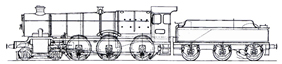
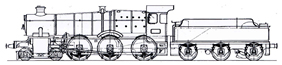
Between 1936 and 1939 eighty-eight locomotives of the 4300 series and twenty of the 8300 series were withdrawn from service and their wheels and motions were used in the construction of the Grange (6800) and Manor (7800) classes.
| |
4300 class |
 |
6800 class |
 |
7800 class |
Many more would have been converted but for the war which stopped the rebuilding programme.
|
Date Built |
BR Numbers | Quantity |
No. in Service |
| 1911 | 4301-20 | 20 | 20 |
| 1913 | 4321-40 | 20 | 40 |
| 1913-14 | 4341-60 | 20 | 60 |
| 1915 | 4361-80 | 20 | 80 |
| 1916 | 4300/ 4381-99/5300-5 | 26 | 106 |
| 1917 | 5306-37 | 32 | 138 |
| 1918 | 5338-59 | 22 | 160 |
| 1919 | 5360-79 | 20 | 180 |
| 1920 | 5380-99/6300-6 | 27 | 207 |
| 1921 | 6307- 41/6370-99/7300-2/7305-18 | 82 | 289 |
| 1922 | 7303-4/7319 | 3 | 292 |
| 1923 | 6342-61 | 20 | 312 |
| 1925 | 6362-69/7320-21 | 10 | 322 |
| 1932 | 7322-41 | 20 | 342 |
5300-99 originally 8300-99 renumbered between 1944 and 1948
7322 were built as 9300 – 9319 and between 1956 and 1959 converted to 4300 class. They were fitted with side window cabs.
6320 was converted for oil burning in 1947 and reconverted to coal burning in 1949.
7300-7304 had detail alterations which made them heavier.
Eleven examples of the class were transported to France during World War I in the service of the Railway Operating Division of the British Army and these were 5319 – 5326 and 5328 – 5330. They were based at Audruicq which was on the line between Calais and St Omer. The engines hauled 1,000 ton trains of war supplies between railway yards outside Calais at Les Fontinettes and the military railheads east of Hazebrouck with supplies for the British Second army around Ypres Salient.
One hundred and sixty-three members of the class were fitted with outside steam pipes and new cylinders between July 1928 and August 1958.
Of the 342 built 241 were taken into BR ownership in 1948 following the nationalisation of the railways. Most of the withdrawals prior to this were engines in the 4300-99 series of which only 12 of the 100 built were still in service at the time. 12 of the 5300-99 series and 1 (6315 withdrawn in 1945 following being derailed) of the 6300-99 series were no longer in operation.
All of the 4300-99 locomotives were withdrawn from service by the end of 1959.
Number in Service.
|
31st Dec |
4300 Class | 8300 Class | 9300 Class |
Total |
|
1947 |
220 | 1 | 20 | 241 |
| 1948 |
212 |
20 | 232 | |
| 1949 |
211 |
20 |
231 |
|
| 1950 |
210 |
20 |
230 |
|
| 1951 |
204 |
20 |
224 |
|
| 1952 |
200 |
20 |
220 |
|
| 1953 |
197 |
20 |
217 |
|
| 1954 |
197 |
20 |
217 |
|
| 1955 |
196 |
20 |
216 |
|
| 1956 |
193 |
17 |
210 |
|
| 1957 |
194 |
11 |
25 |
|
| 1958 |
178 |
182 |
||
| 1959 |
149 |
149 |
||
| 1960 | 122 |
122 |
||
| 1961 |
113 |
113 |
||
| 1962 |
68 |
68 |
||
|
1963 |
35 |
35 |
The last 35 locomotives in service were all withdrawn in 1964 from the depots shown below.
| Aberdare |
1 |
| Didcot |
9 |
| Gloucester |
8 |
| Neath |
1 |
| Pontypool Road |
3 |
| Severn Tunnel Junction |
4 |
| Stourbridge |
2 |
| Taunton |
7 |
|
35 |
|
Accidents and Incidents
- On 13 October 1928, locomotive No. 6381 was hauling a freight train that was run into by a passenger train at Charfield in Gloucestershiredue to the driver of the passenger train overrunning signals. Sixteen people were killed and 41 were injured.
- On 1 March 1937, A 4300 Class locomotive hauling a freight train that was in collision with a passenger train at Langley in Buckinghamshire. One person was killed and six were injured.
- On 7 September 1945, locomotive No. 6315 was hauling a mail and freight train that was derailed nearSun Bank Halt near Llangollen in Denbighshire due to the trackbed being washed away following the failure of the bank of the Shropshire Union Canal. One person was killed and two were injured. The train’s consist, except for a brake van, was destroyed in the ensuing fire. The locomotive was repaired and returned to service until withdrawal in October 1945.
- In 1952, locomotive No. 7311 overran a signal and was derailed by trap points atAppleford in Oxfordshire.
- On 6 September 1956, locomotive No. 9306 was hauling a parcels train that overran signals and ran into the rear of an express passenger train at
 Preserved British Steam Locomotives