| Original | Superheated | |
| Weight | 88t 7cwt | 110t |
| Driving Wheels | 5ft 0ins | 5ft 0ins |
| Boiler Pressure | 160psi | 160psi |
| Cylinders | Outside – 20in x 26in | Outside – 21in x 26in |
| Tractive Effort | 22,200lbf | 26,200lbf |
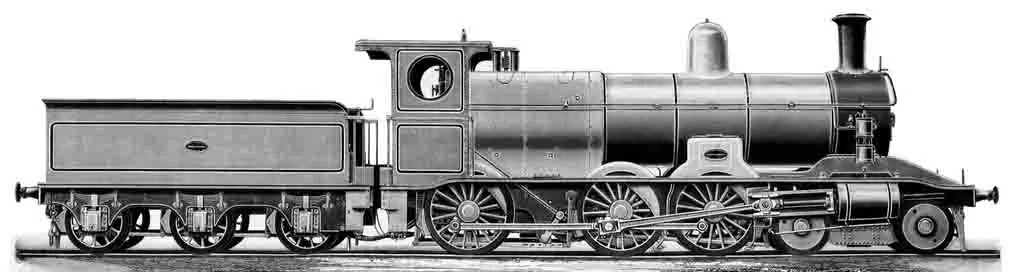
This locomotive was built by Beyer Peacock in 1892 for the New South Wales Government Railway in Australia. It became part of the C32 class although they were regarded as P class until 1924. The locomotive carried the number P492 before being renumbered P465 and then 3237 in 1924.
When the new Chief Commissioner, Edward Eddy, took office in 1888, he was anxious to have additional locomotives manufactured within Australia, and the Government sought the formation of a manufacturing company in New South Wales by interested parties. When this failed, designs were prepared prior to inviting tenders in England.
Beyer, Peacock and Company was selected to build the new locomotives. The first batch of 50 locomotives were delivered between February 1892 and July 1893. They became known as the Manchester Engines.
At the request of the Railway Commissioners, the builders altered the last two engines of the first batch to operate as compounds, but these did not prove satisfactory and during 1901 were converted to 2-cylinders. This particular compound arrangement was never used in any other locomotive in the world.
Further orders over a nine year period saw 191 locomotives built the last being delivered in 1911. Of the 191 106 were built by Beyer Peacock, 20 by Baldwin Locomotive Works, 45 by Clyde Engineering Company of New South Wales and 20 at the Eveleigh Workshop of the New South Wales Government Railway.
The initial 50 were built with six wheel tenders, the remainder with eight wheel bogie tenders. Many of the originals were later equipped with bogie tenders, however a number of the class kept the shorter tenders to enable them to be turned on the 50-foot turntables at certain locations.
The final engine was built with a superheater, and tests showed a significant improvement in performance; as result the remaining 190 engines were similarly fitted as they became due for boiler renewal between 1914 and 1939.
The alteration raised the boiler four inches, which actually improved their riding quality. With this alteration and the superheating, the old engines were given a new lease of life. They were known to have attained speeds of over 70mph, in spite of their small driving wheels.
Initially the class were used to haul the Northern and Southern mail and express trains. Following the strengthening of the Wagga Wagga Viaduct in 1901, they worked the full length of the Main South line from Sydney to Albury, the express covering the 621 km in 12 hours and 35 minutes, including 14 stops.
Apart from some very light country branch lines, the class worked throughout the state. They worked almost all South Coast line passenger services right up until the end of steam. They were equally at home on commuter services to Campbelltown or Richmond; on Newcastle suburban trains as far as Singleton and Dungog; on country branch line mixed or goods trains or even the Riverina Express from Narrandera to Griffith.
In the 1950s, it was found that the original low frames of the class were cracking causing most of the class to be reframed with higher frames.
The first of the class to be withdrawn was 3264 following an accident at Otford in July 1956. Following the arrival of the 48 class diesels from 1959, withdrawals began in earnest. On 24 July 1971, the last regularly steam-hauled passenger train in New South Wales was hauled by class C32 locomotive 3246 from Newcastle to Singleton.
The last member of the class was withdrawn from service in December 1971 – it had been deployed on shunting duties at Goulburn Depot.
One member of the class covered over 2.6 million miles whilst in service which was the highest distance covered by any New South Wales steam engine.
Works number 3413 (NSWGR No 3214) was one of a handful of locomotives of the C32 class that survived in operation into the 1960s. It was withdrawn from service in March 1970 but was retained for the New South Wales Rail Transport Museum (NSWRTM) at Enfield in the roundhouse.
Under the ownership of the NSWRTM the locomotive was maintained as a working engine and as well as being an operational exhibit at the museum was used on various vtour trains around the state.
Subsequently the NSWRTM was evicted from the roundhouse at Enfield to make way for a proposed container depot. The locomotive assisted in the move to the new museum site at Thirlmere by hauling some of the exhibits to the new site in 1975.
In the late 1970s the locomotive carried a lined maroon livery and towards the end of its operating days the smokebox was decorated with a star as a reminder of how the locomotives were turned out in the 1920s when hauling the Newcastle Express.
The locomotive was withdrawn from service in 1982 due to deteriorating boiler condition and the it was placed on static display in the Thirlmere train shed. In 1988 the rather worn and faded lined maroon livery was replaced by a quick spray coat of basic black.
Around 2005 the locomotive was moved to the roundhouse at Valley Heights Locomotive Depot Heritage Museum.
Subsequently the locomotive has been cosmetically restored and placed on static display at Valley Heights Locomotive Depot Heritage Museum.
Three other members of the class built by Beyer Peacock are preserved.
Three other members of the class built by Beyer Peacock are preserved.
- 3203 – Works number 3402 built in 1891
- 3237 – Works number 3436 built in 1892
- 3265 – Works number 4221 built in 1901
 Preserved British Steam Locomotives