| Power Classification | 2P reclassified 1P in 1953 |
| Introduced | 1884 – 1909 Rebuilt from 1911 by S D Holden |
| Designer | J Holden |
| Company | GER |
| Weight | 53t 19cw |
| Driving Wheels | 5ft 4ins |
| Boiler Pressure | 180psi |
| Cylinders | Inside – 17½in x 24in |
| Tractive Effort | 17,570lbf |
| Valve Gear | Stephenson (slide valve) |
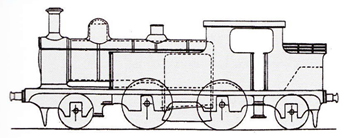
The history of the GER 2-4-2T locomotive can be traced back to the Worsdell design when 160 engines were introduced in 1884 of what later became the LNER F4 class. These locomotives were heavy on coal consumption and were given the nickname Gobblers.
The James Holder version (LNER class F3) had 5ft 8in driving wheels compared with the earlier Worsdell locomotive whose driving wheels were of 5ft 4in diameter. Fifty of these engines were built as the GER C32 class and they had a lot of variations in the boiler mountings (chimneys, domes and safety valves).
The S D Holden (The son of James Holden) locomotive introduced as the GER class Y65 class and subsequently the LNER F7 class were smaller than all of the other 2-4-2T engines on the GER. Twelve of these engines were built specifically for light branch work for which they were equipped for push-pull operation.
The LNER class F5 engines were rebuilt from 1911 onwards from F4 class locomotives built at Stratford between 1903 and 1909. These engines had higher pressure boilers and as with the class F3 tanks there was a lot of variation in the boiler mountings (chimneys, domes and safety valves).
Some of these F5 engines were fitted with condensing apparatus and had their chimney reduced in height to enable them to work the London Passenger Transport Board Circle Line if the electricity supply was disrupted due to enemy action during the Second World War.
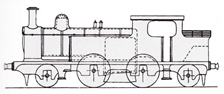 |
LNER class F4 introduced on the GER by Worsdell in 1884 |
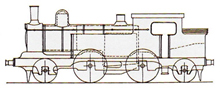 |
LNER class F3 introduced by James Holden on the GER in 1893 |
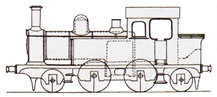 |
LNER class F7 introduced by S D Holden on the GER in 1909 |
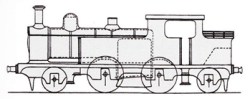 |
LNER class F5 introduced by S D Holden on the GER in 1911 |
In 1940 1 class F5 along with 15 class F4 engines were loaned to the military for hauling coastal defence units during the Second World War until 1943. These locomotives were given addition of armoured plating and were later fitted with plaques to commemorate their war service. They were allocated to various towns all the way from Canterbury to Aberdeen.
The first withdrawal of the 2-4-2T engines was a Worsdell locomotive which was withdrawn in 1913. Only 30 class F5 tanks survived into LNER ownership at Grouping in 1927 and these 30 were subsequently taken into BR stock in 1948. These numbers exclude two engines (BR 67218-9) were taken into LNER and BR stock as F6 tanks but were correctly identified being class F5 locomotives in December 1948 which enabled them to have a wider route availability. These two engines had side windows.
Most of the F5 class engines spent their lives working the London suburban services, until being replaced by N7s. They then hauled services throughout East Anglia.
Number in BR Service.
| BR Numbers | Quantity | Withdrawals |
No. in Service |
|
| 1947 | 67188 – 67217 |
30 |
||
| 1948 | 67188 – 67219 |
32 |
||
| 1954 |
32 |
|||
| 1955 |
14 |
18 |
||
| 1956 |
6 |
12 |
||
| 1957 |
7 |
5 |
||
| 1958 |
5 |
0 |
Locomotive allocations during British Railways operation (including 67218-9)
|
As at 1st January |
1948 | 1953 | 1955 | 1956 | 1857 |
1958 |
| Colchester |
5 |
5 | 4 | 3 | 1 |
1 |
| Lowestoft | 4 | 7 |
4 |
|||
| Parkeston |
2 |
|||||
| Stratford |
25 |
21 | 19 | 10 | 11 |
4 |
| Yarmouth South Town | 2 | 2 |
1 |
|||
|
32 |
32 | 32 | 18 | 12 |
5 |
- The last four engines were withdrawn from service in May 1958 whilst based at Stratford.
- Locomotives allocated to Stratford included those based at Epping for working the Epping to Ongar shuttle.

