| Weight | 281t (later 291t) |
| Length | 108ft 7ins |
| Driving Wheels | 4ft 7ins |
| Boiler Pressure | 200psi |
| Cylinders | Four Outside – 19.25in x 26in |
| Tractive Effort | 59,560lbf |
| Valve Gear | Walschaert |
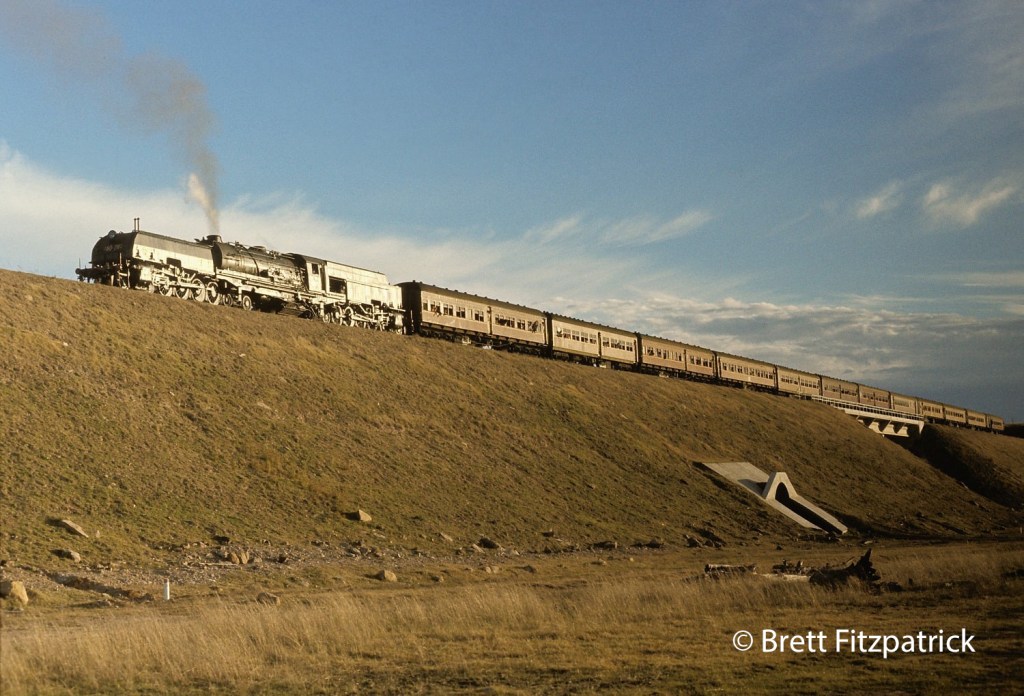
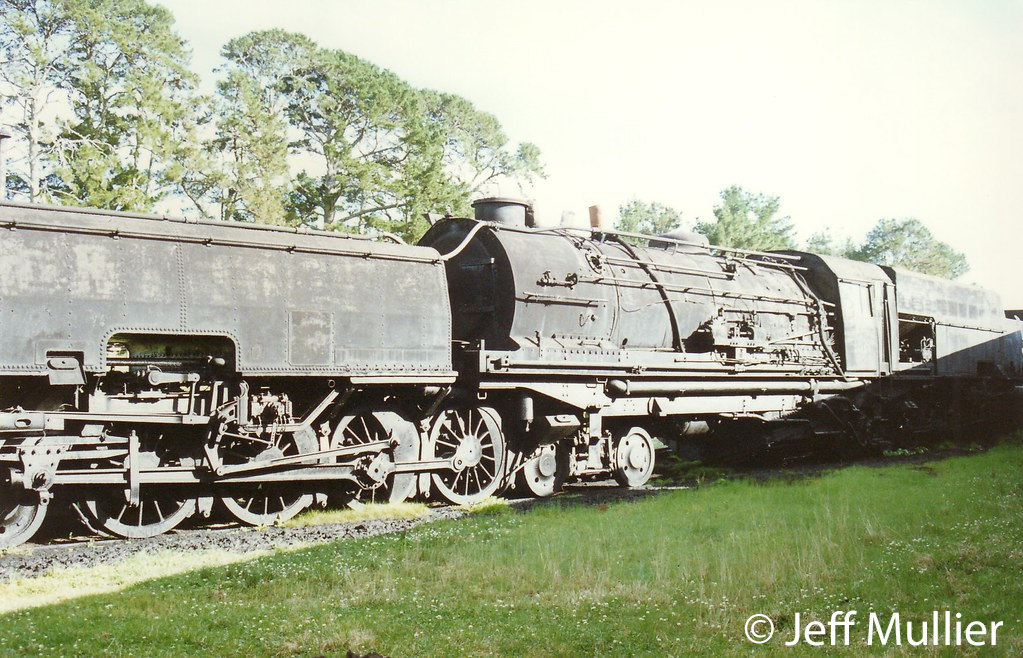
This locomotive was built in 1956 by Beyer Peacock for the New South Wales Government Railways (NSWGR) in Australia. It was one of 42 built to a Beyer-Garratt patent which consisted of a boiler carried on a separate frame in the centre of the locomotive and supported by the frames of the two engines, one at each end. The locomotive thus consists of three parts: a front engine unit carrying a water tank, an intermediate chassis pivoted to each engine unit supporting a boiler and cab, and a rear engine unit carrying a coal bunker and water tank.
These class AD60 locomotives were the only type of Garratt to operate on the NSWGR. They were designed to have a light axle load and were intended for hauling feeder branch-line services to the main lines where heavier main-line locomotives could continue with the load.
The initial order placed with Beyer Peacock in 1949 was for 50 locomotives but following a change in policy by the NSWGR to move to diesel traction the order was amended to 42 complete locomotives plus spares for a further 5. The sets of spares parts did not include engine unit frames. The last three locomotives were cancelled completely and were subsequently delivered to the South African Railways. The locomotives supplied to the NSWGR were delivered in their five major component pieces – front engine, rear engine, boiler-cab, rear bunker and front water tank. These five sub-assemblies were then built into a complete locomotive in NSW. The first locomotive entered service in July 1952.
The locomotives were the most powerful to operate in Australia.
Early trials established that the bunker was insufficient to allow the locomotives to operate from Enfield to Goulburn resulting in the bunkers being enlarged. This locomotive which carried the number 6039.
Ventilation of the cabs caused considerable concern and consequently, the class was banned from working through single-line tunnels.
Owing to the length and noise of the locomotive, crews found difficulty in hearing warning detonators. To rectify the situation, tubes were fitted to convey the sound from the leading wheels to the cab.
When it became apparent that the Garratts would see more service on main lines than on the lighter branch lines, it was decided to increase the tractive effort of a number of the class by enlarging the cylinder diameter and by altering the weight distribution by removing liners from the bogies. This increased the axle load on each of the driving wheels by approximately 2 tons with 30 locomotives treated. To distinguish these improvements the double plus sign ++ was painted after the number and they were nicknamed Super Garratts. These 30 were also fitted with dual controls for bunker first running and denoted DC. To accommodate them, 105-foot turntables were installed at Broadmeadow, Enfield and Werris Creek depots.
The class initially entered service on the Main North and Main South and later Main Western line as far as Dubbo and Parkes. Because of their light axle load they were cleared to operate on the Crookwell, Captains Flat, Temora, Narrandera and Bourke lines.
The first member of the class was withdrawn from service in 1955. A few were withdrawn in 1961 after suffering damage in major collisions. The rest were withdrawn from service as a result of the introduction of diesel traction from 1965.The last (number 6042) was withdrawn in March 1973 and is one of four preserved.
6039 were among the last NSWGR steam locomotives to work in revenue service and ended its days hauling heavy coal trains in the Newcastle district. It was condemned in January 1973.
After being withdrawn from service the locomotive was stored at the Enfield depot in Sydney for a year or so. It was then purchased for the proposed Hunter Valley Steam Railway & Museum in 1974 for $5,000.
As the Enfield site was wanted for a proposed container depot the locomotive was moved to Thirlmere. In the event the container depot was not built.
6039 was stored at Rhondda Colliery near Newcastle from 1974 where it was joined by other Hunter Valley Steam Railway & Museum (HVSR&M) exhibits.
A frame crack in the front engine unit of the locomotive was repaired at the Broadmeadow Depot in 1977 after which it hauled a number of excursions in the Newcastle district.
One railtour from Broadmeadow to Mt Thorley in July 1978 ended badly. The problem arose because the coal loader operator at the Mt Thorley Colliery refused to allow the train to remain standing on the balloon loop to enable the locomotive to take a full tank of water, despite it being arranged some months previously. As a result, on the return working of the train, 6039’s injectors stopped working some miles short of the next place where it could water. The locomotive’s owners took the decision to stop the train at that point and drop the fire so the boiler would not get damaged.
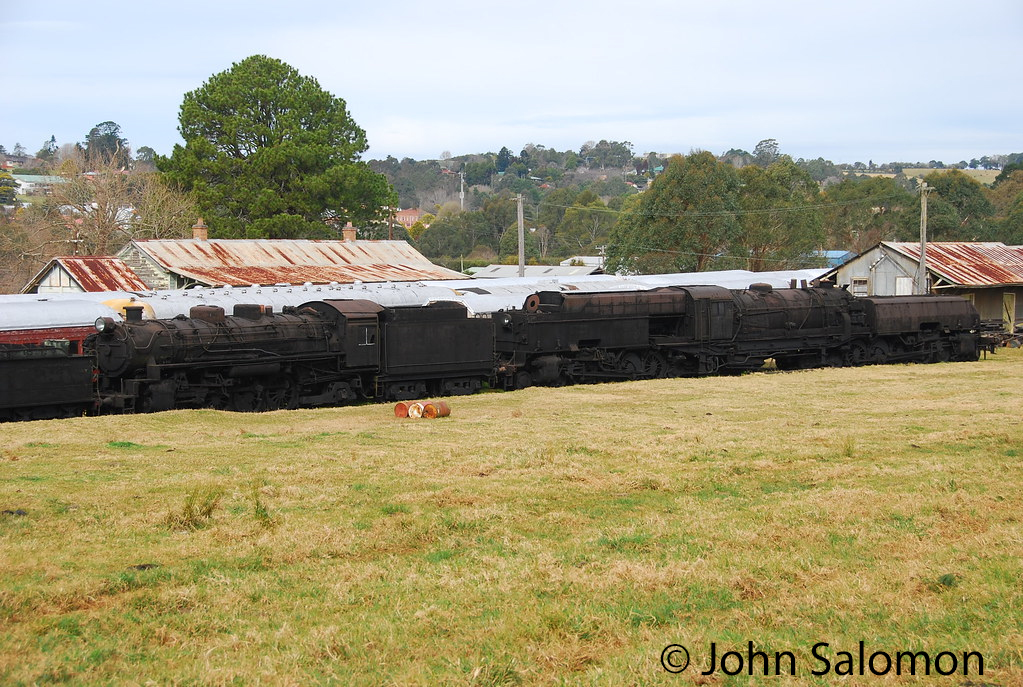
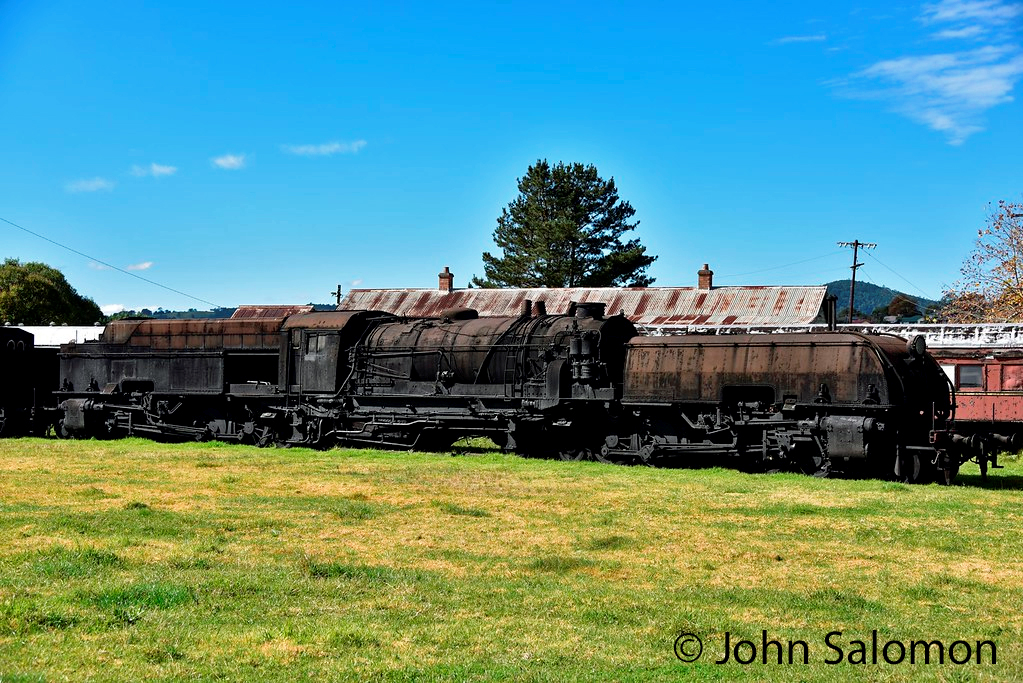
The HVSR&M changed their objective to reopening the Dorrigo branch line on the mid-North Coast region of New South Wales and a railway museum at Dorrigo. The museum is now named the Dorrigo Steam Railway & Museum (DSR&M). Most of the steam locomotives owned by the HVSR&M were hauled from Rhondda Colliery to Glenreagh during December 1983. 6039 was one of the locomotives that was moved on to Dorrigo in July 1986 when the branch line to Dorrigo had been re-opened.
The Dorrigo region is known for its sub-tropical climate and the torrential rainfall at Dorrigo has not been kind to the collection of wooden carriages stored there. Rapid vegetation growth in this rainforest region has since reclaimed much of the Dorrigo branch line. Alas the Dorrigo museum and associated tourist railway is yet to open to the public. 6039 and other steam locomotives are regularly coated in black oil to protect against the elements.
There are three other members of the class preserved.
- 6029 – Beyer Peacock works number 7531
- 6040 – Beyer Peacock works number 7542
- 6042 – Beyer Peacock works number 7544
Back to Preserved Outside Britain – By Country
 Preserved British Steam Locomotives